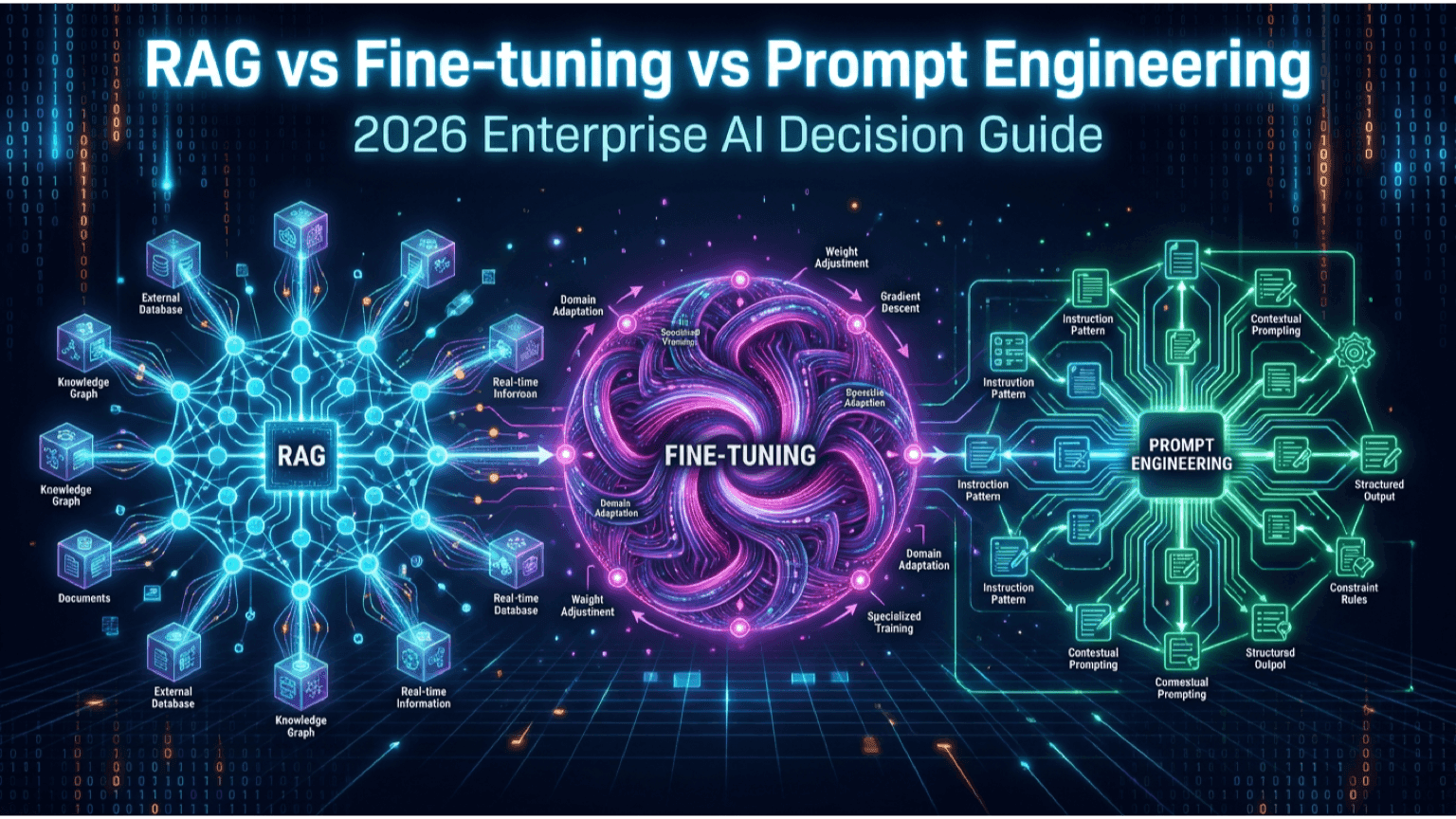
RAG vs Fine-tuning vs Prompt Engineering: 2026 Enterprise AI Decision Guide
Three years into the GPT-4 era, the question that lands on enterprise CTO desks has shifted.
It's no longer "should we use AI." It's "for this specific use case, do we use a base model with prompt engineering, ground it with RAG, or fine-tune?"
The wrong answer wastes 3-6 months and a budget that doesn't get re-approved. The right answer is rarely "just one of these" — it's usually a layered combination chosen against specific failure modes.
This guide explains what each technique actually does, where each wins and fails, when to combine them, and the 6-factor decision matrix that lands the call.
Internative has deployed all three across client production systems through our Koordex AI operations layer. The cost ranges and failure patterns here come from those projects.
What Each Technique Actually Does
Prompt Engineering
You construct the input to the LLM carefully so the response comes back in the shape you need. No external data, no model changes. The model's only knowledge of your problem comes from what you put in the prompt.
This includes: system prompts, few-shot examples, chain-of-thought scaffolding, structured output specifications, role-play framing.
RAG (Retrieval-Augmented Generation)
You build a search system over your own data. At query time you retrieve the most relevant chunks and put them into the prompt as context. The LLM answers from the context you injected.
The model never sees your full corpus. It only sees the slice retrieved for this query.
Fine-tuning
You take a base model and continue training it on a dataset of input/output examples that represent your specific task or domain. The model's weights change. The new model behaves differently than the base model on the kinds of inputs you trained it on.
There are flavors: full fine-tuning, LoRA (low-rank adaptation), instruction-tuning, RLHF. The cost and complexity differ significantly across flavors.
Where Prompt Engineering Wins
- Tasks where the base model already knows the domain: summarization, generic writing, translation, code explanation
- Low-volume usage where iteration speed matters: 100 queries a day, tuning the prompt is faster than building a RAG pipeline
- Tasks with no proprietary knowledge: extraction, classification of public-domain content
- Quick prototyping: validate the approach in 2 days before investing in RAG or fine-tuning
Cost: Just the API calls. $0.0001-$0.01 per query depending on model and length.
Where it fails: Anything that requires knowledge of your company's specific data, documents, customer history, or product details. The model will confidently hallucinate.
Where RAG Wins
- Question answering over your company's documents: support knowledge bases, internal wikis, policy documents, technical documentation
- Tasks requiring up-to-date data: model training cutoff is months or years old; RAG retrieves current data
- Customer-specific responses: each customer's tickets, contracts, history needs to inform the answer
- Citable answers: regulated industries (legal, healthcare, finance) need source attribution; RAG provides it natively
- Large corpora that don't fit in context: even with 200K context windows, you can't fit 10,000 documents into every prompt cheaply
Cost: Setup is $20K-$200K depending on corpus complexity. Per-query cost is $0.001-$0.05 (retrieval embeddings + LLM call).
Where it fails: When the corpus is poorly structured or low quality. RAG amplifies the quality of your underlying data — garbage in, garbage out at scale.
Where Fine-tuning Wins
- Domain-specific language and style: legal contracts, medical reports, internal company tone, specific code patterns
- Tasks where prompt becomes ridiculous: if your prompt to a base model needs 5,000 tokens of instructions to behave correctly, fine-tuning trims that to 50 tokens
- Latency-critical use cases: smaller fine-tuned models can match larger base models on narrow tasks at 10x the speed
- Cost reduction at scale: million+ queries per month, a fine-tuned smaller model is dramatically cheaper than GPT-4 with long prompts
- Output structure consistency: when format compliance matters more than reasoning depth
Cost: $5K-$50K for LoRA on a single task. $50K-$500K for full fine-tuning at enterprise scale. Per-query cost can be 10-100x lower than base model calls.
Where it fails: When the underlying knowledge changes frequently. Fine-tuned models go stale. When the task is more reasoning than style. When training data isn't large or clean enough (you need at least 100-1,000 high-quality examples).
The Comparison Table
Dimension | Prompt Engineering | RAG | Fine-tuning
Setup cost | Minimal | $20K-$200K | $5K-$500K
Per-query cost | High (long prompts) | Medium | Low
Time to first version | Hours | Weeks | Months
Knowledge freshness | Static (model cutoff) | Real-time | Static (training cutoff)
Domain customization | Limited | High (data-driven) | Highest (behavior-changing)
Citation/traceability | None | Native | None
Latency | Medium | Medium-High | Lowest
Hallucination control | Limited | Strong (grounded) | Limited
Maintainability | Easy | Medium | Hard
Best for | Quick wins, generic tasks | Knowledge-grounded answers | Style, format, scale
The Production Pattern: Layered, Not Picked
In practice, mature enterprise deployments use all three layered together:
- Prompt engineering sets the task structure, output format, and constraints
- RAG injects current proprietary knowledge into the prompt
- Fine-tuning (when applicable) handles style, format compliance, and per-query cost reduction
A real example from a Koordex deployment:
A B2B SaaS support automation. The base model is fine-tuned for the company's product tone and standard response structure. RAG pulls in the customer's specific account history and the relevant knowledge base articles. The prompt enforces output format and escalation rules.
Result: 83% of support tickets resolved automatically. Cost per ticket dropped from $4.20 (human handling) to $0.06.
No single technique would have hit that. Each handled what it's actually good at.
6-Factor Decision Matrix
Score your use case on each factor. The weighting tells you which technique to lead with.
Factor | Leads to Prompt | Leads to RAG | Leads to Fine-tuning
Proprietary data needed? | No | Yes | Sometimes (for style)
Knowledge freshness needed? | No | Yes | No
Citation required? | No | Yes | No
Query volume? | Low | Medium | High
Latency budget tight? | No | Medium | Yes
Style/format critical? | No | No | Yes
A use case scoring "Yes" on the first three rows leads with RAG. Scoring "High volume + tight latency + format-critical" leads with fine-tuning. Scoring all "No" on RAG/fine-tuning indicators stays with prompt engineering.
The Three Common Mistakes
Mistake 1: Jumping to fine-tuning when RAG would work. The most common enterprise pattern in 2024-2025. "We need a custom model for our domain" was usually a RAG problem in disguise. Fine-tuning is now the right tool for fewer use cases than people think.
Mistake 2: Trying to solve RAG problems with prompt engineering. "We just need a better prompt" is the answer 3 weeks before someone realizes they need RAG. Every time the model hallucinates on company-specific data, it's a RAG-shaped gap.
Mistake 3: Building RAG when prompt engineering would have worked. The opposite trap. Over-engineering a RAG pipeline for a task where the base model already has the knowledge. Wasted weeks and a more brittle system.
Five Questions That Resolve the Choice
- Does the model already know enough to answer correctly? Test 50 representative queries with prompt engineering only. If it works, stop building.
- Where do the errors come from? Wrong information about your data → RAG. Right information, wrong format/style → fine-tuning. Right information, wrong reasoning → better prompts.
- What's the query volume per month? Under 10K — prompt engineering or RAG. 10K-1M — RAG. Over 1M with format consistency — fine-tuning is worth the investment.
- How often does the underlying knowledge change? Daily or weekly — RAG only. Monthly — RAG or fine-tuning. Annually — fine-tuning becomes viable.
- Does the use case require source attribution? Yes — RAG is structurally required. No — other options open.
What This Looks Like in Production
The systems that work in production aren't picking one. They're picking the right layer for each problem and using a router (Koordex or similar AI ops layer) to send each query through the right pipeline.
Most enterprises in 2026 will end up with three or four production AI pipelines, each using a different combination of prompt engineering, RAG, and fine-tuning, plus an AI ops layer that orchestrates between them.
The decision isn't "RAG vs fine-tuning." It's "what's the right pipeline for this specific use case, and how do we build the ops layer that runs all our pipelines."
Related Reading
- LLM Cost Optimization: 7 Patterns That Cut Bills by 40%
- Multi-Agent AI Systems for Enterprise: 6 Architecture Patterns (2026)
- AI Strategy Roadmap: A 90-Day Framework for CTOs (2026)
- Custom Software ROI Calculation Framework (2026)
Next Step
If you're scoping an enterprise AI use case and unsure which pipeline fits, we run 30-minute architecture calls where we look at your specific use case and recommend the right layer combination.
Contact: team@internative.net or via internative.net.
Related reading: AI integration services — how to add AI to your existing software
Related services
Where this topic becomes an engagement.
Keep reading
More articles from Blog.