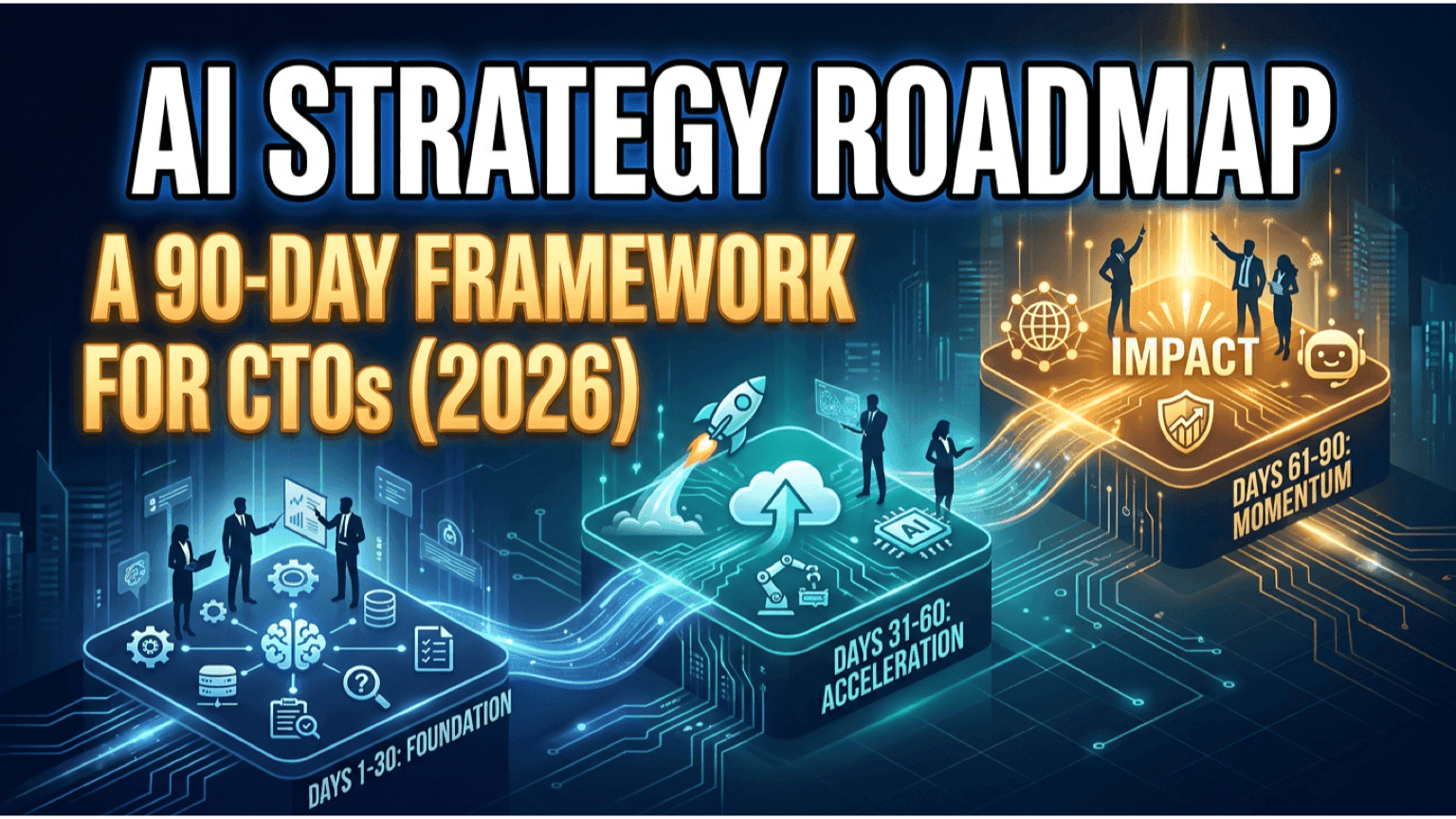
AI Strategy Roadmap: A 90-Day Framework for CTOs (2026)
Most enterprise AI strategies fail in execution, not in concept.
The board approves the strategy deck. The CTO commissions a vendor evaluation. Twelve months later, the deck is on a shelf, three pilots are stalled, and someone asks why the budget became three times what was planned.
The strategies that work in 2026 share a common shape: they're built in 90 days, not 9 months. They start with where the company actually is, not where consultants think it should be. They focus on shipping 2-3 production deployments in the first year, not boiling the AI ocean.
This article is the 90-day framework we use with clients moving from "we should do AI" to "we're shipping AI in production." It draws on AI deployments across enterprise clients through Koordex and our AI Studio service.
The Big Picture: Three Phases in 90 Days
- Days 1-30: Assess. Where are we, what's possible, what's the cost of inaction?
- Days 31-60: Design. What are we going to build, who owns it, what's the budget?
- Days 61-90: Decide and start. Approve, contract, kick off the first 2-3 use cases.
Day 91 you're not done. You're shipping.
Days 1-30: Assess
Week 1: Readiness Audit
Before AI strategy, you need a clear-eyed view of where you are. We use a 5-dimensional readiness audit (28 questions across data, process, people, culture, infrastructure).
Skipping this step is the most common reason AI strategies fail later. Companies launch ambitious plans against infrastructure or data foundations that can't support them.
Output of week 1: a readiness score per dimension (out of 84 total) and a list of the 3-5 weakest factors.
Week 2: Inventory + Discovery
Catalog what's already happening:
- Existing AI experiments (often shadow projects in marketing, support, or engineering)
- Vendor demos already in flight
- Tools already deployed (Copilot, Notion AI, Salesforce Einstein)
- Data assets that could become AI-ready (warehouses, CRMs, support knowledge bases)
- Process pain points where business owners have been asking for solutions
Run 8-15 stakeholder interviews. Two questions in each: "Where does AI feel like it would help your team?" and "What's stopping you from trying?"
Output of week 2: a stack rank of 15-30 candidate use cases with rough size-of-prize estimates.
Week 3: Competitive + Regulatory Context
- Where is your industry on AI adoption (early, mid, late majority)?
- What are competitors deploying (public moves, hiring signals, vendor partnerships)?
- What regulatory frames apply (EU AI Act, GDPR/KVKK, HIPAA, sector-specific)?
- What's your risk tolerance vs. the cost of being late?
Output of week 3: a strategic positioning summary — defender, fast-follower, or pioneer in your industry.
Week 4: Cost of Inaction
This is the question that gets the board's attention.
For each of the top 5 use cases identified in week 2:
- What's the annual operational cost of the current process?
- What's the realistic AI-enabled cost?
- What's the gap?
- Multiply by 3-5 years.
Most enterprises find $10M-$100M of compounding inefficiency they're paying for by not deploying AI. That number, not "AI is cool," is what gets the budget approved.
Output of week 4: a 1-page board summary with the cost-of-inaction number, the readiness score, and a recommendation for the next 60 days.
Days 31-60: Design
Week 5: Pick the 2-3 Use Cases
The biggest mistake is picking too many. Pick 2-3 use cases that:
- Score high on readiness (data, process, people in place)
- Score high on business impact (real money, real users)
- Score high on tractability (can ship a working version in 90 days post-design)
Score each candidate on a 3x3 grid (readiness x impact x tractability). The top right wins.
Reject candidates that are "interesting but the data isn't there yet" — they're year 2 work.
Week 6: Architecture Decisions
For each picked use case, lock in the architecture decisions:
- Build vs Buy vs Modify: Is this best as a custom build, a SaaS purchase, or extension of something you have?
- Model strategy: Which LLM provider(s)? Router-based or single-vendor?
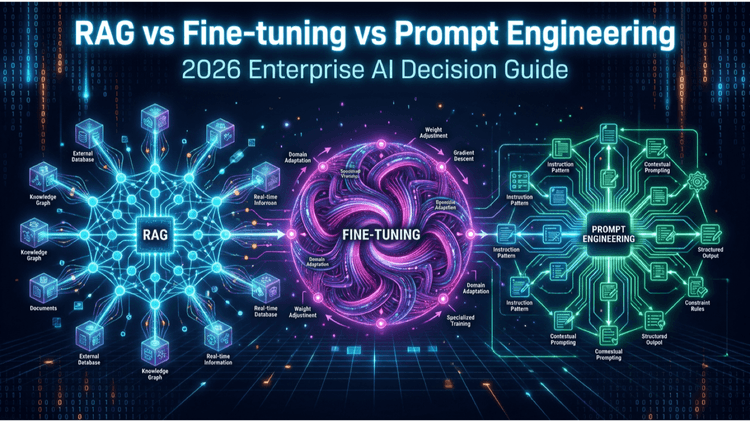
- RAG vs fine-tuning vs prompt engineering: Which technique fits?
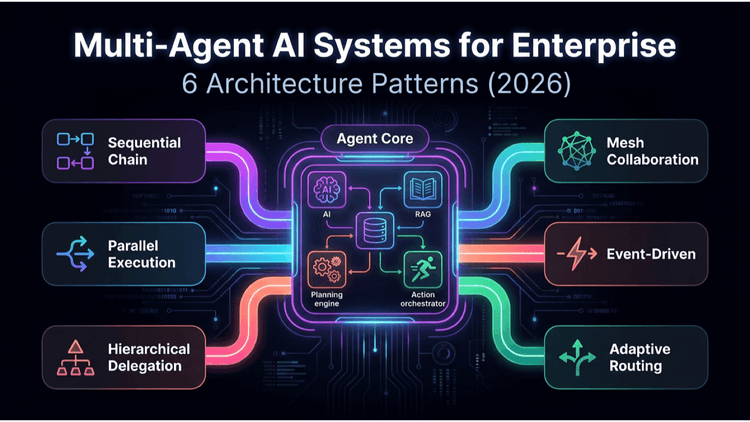
- Tool / agent architecture: Single-agent, planner-executor, hierarchical?
- Data plane: Where does the data live, how does it flow, who can access it?
If your team doesn't have the depth to make these decisions, this is where a vendor or advisory partner comes in. Don't make these decisions on the basis of a single demo.
Week 7: Team and Ownership
For each use case:
- Business owner (P&L responsibility for the outcome)
- Tech owner (architecture and delivery responsibility)
- Operating model (in-house team, vendor, hybrid)
- Success metrics (what does "working" look like, when do we measure)
- Escalation path (who decides if it's going wrong)
The single most predictive factor for AI deployment success is whether each use case has a clear business owner. "AI projects without a business owner" is shorthand for "projects that die in month 9."
Week 8: Budget, Timeline, Governance
- Budget: discovery + build + first-year run-rate per use case
- Timeline: 90-day discovery, 90-day MVP, 90-day production hardening
- Governance: AI Risk Committee, ethics review process, data access controls
- Compliance: EU AI Act readiness, KVKK/GDPR review, sector regulations
Output of week 8: a 12-month execution plan covering all 2-3 use cases, with budget, ownership, and governance defined.
Days 61-90: Decide and Start
Week 9: Board Approval
Take the cost-of-inaction analysis from week 4, the prioritized use cases from weeks 5-6, the team plan from week 7, and the budget from week 8 to the board.
Three slides:
- What we found in the assessment (cost of inaction, readiness)
- What we recommend (the 2-3 use cases, their ROI, the timeline)
- What we need (budget, governance approval, resource allocation)
Decision points the board needs to make:
- Approve budget for the 2-3 use cases
- Approve governance structure
- Approve team / vendor mix
- Set executive sponsor
Week 10: Vendor Selection (If Applicable)
If you're using vendors for any of the 2-3 use cases:
- Send the 38-question vendor checklist (or your equivalent)
- Shortlist 3 vendors per use case
- Run 30-minute structured calls
- Make the picks within 2 weeks (don't slip into a 3-month evaluation)
Week 11: Discovery Contracts
Sign discovery contracts (separate from build contracts) for each use case. Discovery is 2-4 weeks, fixed fee, separate from the main project. This is non-negotiable for any project over $200K total.
Output of discovery: technical spec, risk registry, milestone plan, cost estimate, KPI framework.
Week 12: Kickoff
By day 90, you should be:
- Board-approved budget for 2-3 use cases
- Vendors selected and contracted for discovery
- Internal teams identified with named owners
- Governance structures in place
- Discovery work starting day 91
If you're not at this state by day 90, something went wrong in the framework. Diagnose where: assessment too shallow, design too ambitious, board approval delayed.
The Three Common Mistakes
Mistake 1: Building strategy in the abstract. "What is our AI strategy" generates a deck. "What 2-3 use cases will we ship in the next 12 months" generates a roadmap. Always anchor strategy in specific use cases.
Mistake 2: Picking too many use cases. Twelve use cases in year 1 = zero shipped. Three use cases in year 1 = two shipped successfully. Constraint is the friend of execution.
Mistake 3: No business owner per use case. The technical team will deliver. Without a business owner driving adoption, it sits unused. This is the single most common pattern of "we shipped AI but it didn't change anything."
What Year 2 Looks Like
After 90 days of strategy and 270 days of execution, year 2 starts with:
- 2-3 use cases in production, generating measurable impact
- An AI ops layer (router, monitoring, governance)
- A team that knows how to ship the next 5 use cases
- Budget and board pattern established
Year 2 is where AI strategy expands from "shipping" to "compounding." The companies that did year 1 right have an unfair advantage by year 2.
Five Questions to Resolve the First Step
- Have you done a readiness audit? If no — start there. Don't write strategy on top of unknown foundations.
- Do you have a cost-of-inaction number? If no — calculate it. Without this, the board approves cautiously and the strategy gets diluted.
- Do you have business owners for each candidate use case? If no — find them before writing the strategy. Use cases without owners are dead use cases.
- What's your discovery posture? If you're approving full project budgets without separate discovery — you're at high risk. Make discovery a separate decision gate.
- What's your AI governance frame? If you don't have one — EU AI Act and similar regulations are forcing it. Better to build governance pre-deployment than retrofit it later.
Related Reading
- AI Readiness Assessment: 28 Questions for Enterprise CTOs
- RAG vs Fine-tuning vs Prompt Engineering: 2026 Enterprise AI Decision Guide
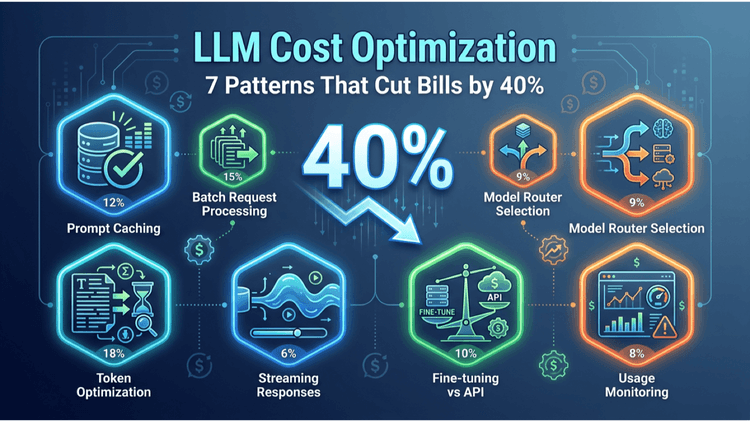
- LLM Cost Optimization: 7 Patterns That Cut Bills by 40%
- Multi-Agent AI Systems for Enterprise: 6 Architecture Patterns (2026)
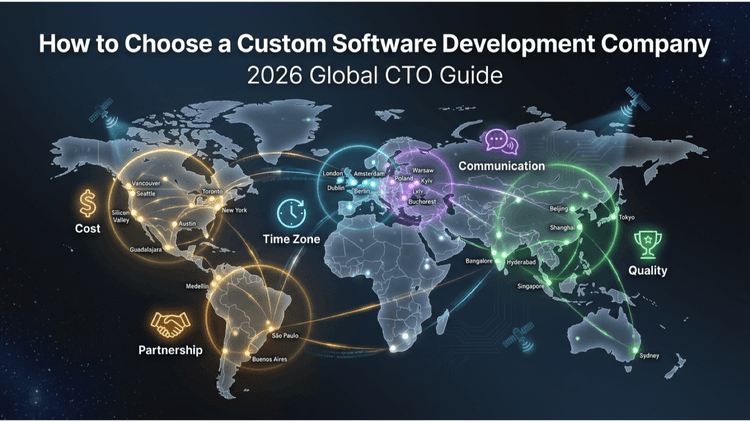
- Enterprise Software Vendor Selection: 2026 CTO Checklist (38 Questions)
Next Step
If you're building or revising your AI strategy and want a second opinion on the framework, we run 30-minute strategy calls where we look at your specific situation and recommend the right next 90 days.
Contact: team@internative.net or via internative.net.
Related services
Where this topic becomes an engagement.
Keep reading
More articles from Blog.