
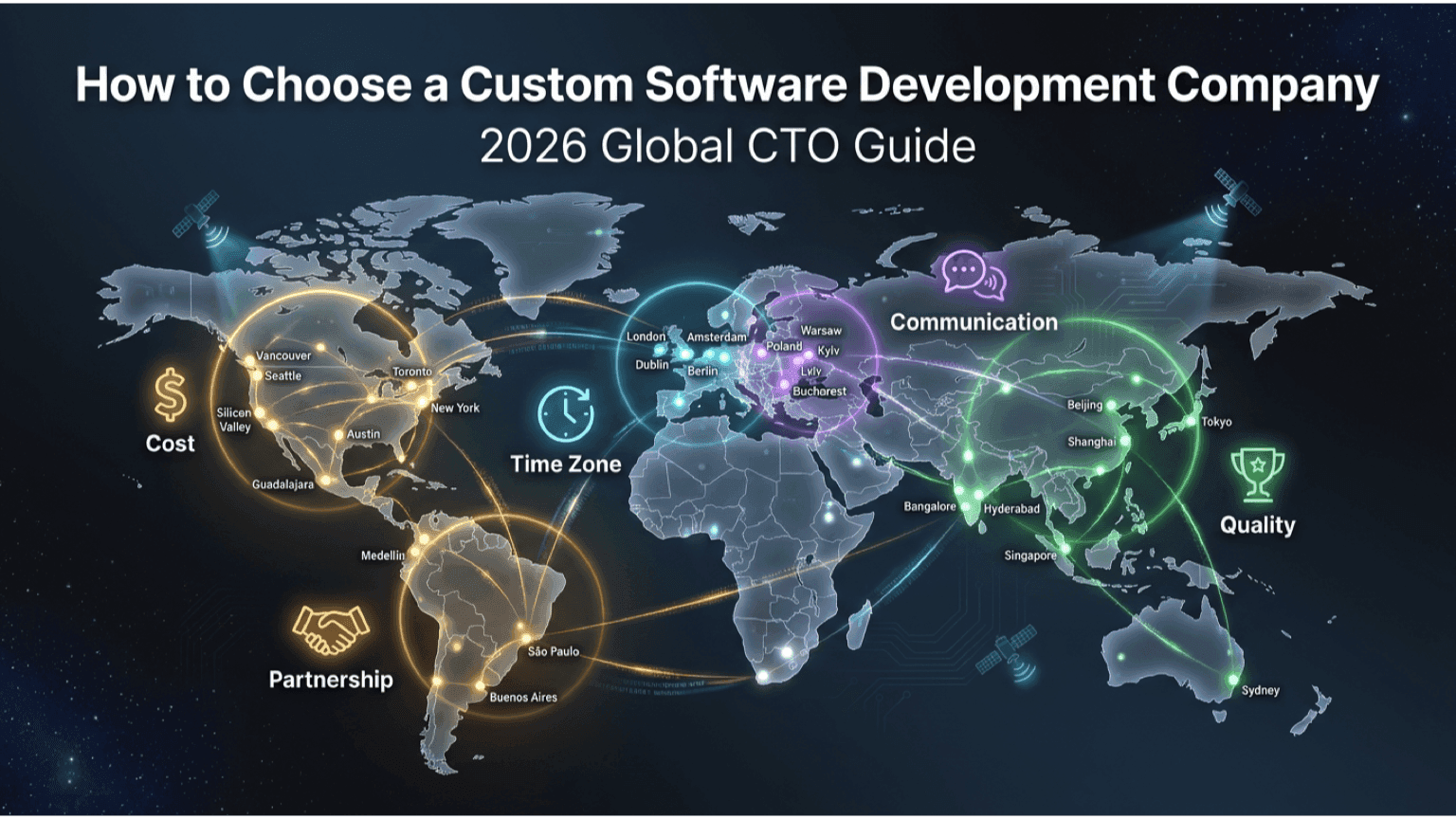
How to Choose a Custom Software Development Company: 2026 Global CTO Guide
Picking the wrong custom software development company is the single most expensive mistake a CTO makes in 2026.
Direct cost: $200K to $5M in wasted spend. Indirect cost: 9-15 months of competitive delay, an executive sponsor's credibility, and a team that learns to distrust outside partners. The damage compounds long after the contract is canceled.
The selection process most enterprises run was designed for staff augmentation in 2015. It doesn't work for the work being bought in 2026: AI-integrated platforms, multi-region SaaS, regulated industry stacks, legacy modernization with active migration.
This guide is the selection framework we wish every CTO had. Sixteen years of running custom software projects, including current work with US, UK, EU, and Turkish clients. It covers the 7 evaluation dimensions that actually predict success, the 3 mistakes that doom selections, and the 12-question shortlist call we use ourselves.
What "Custom Software Development Company" Actually Means in 2026
The category has split into 5 distinct vendor profiles. You're not choosing between vendors; you're choosing between profiles first, then between vendors within a profile.
- Product studios. Design-led, opinionated, work in tight teams of 6-15. Best for greenfield consumer products. Examples: ustwo, IDEO, Work & Co. Rates: $150-$300/hour.
- Enterprise systems integrators. Large, process-heavy, work in pods of 20-100+. Best for ERP-adjacent work, regulated industries, big bets. Examples: Accenture, Deloitte, Capgemini. Rates: $200-$400/hour.
- Mid-size custom development firms. Balanced quality and cost, work in 6-25 person teams. Best for B2B SaaS, internal platforms, AI integrations. Rates: $50-$150/hour depending on region.
- Specialist boutiques. Deep in one stack or one vertical (Salesforce, AI, fintech, healthtech). Best when the project requires very specific expertise.
- Nearshore/offshore engineering firms. Cost-driven, work at scale, 20-200 person engagements. Best for high-volume engineering with stable scope. Rates: $25-$90/hour.
Picking the wrong profile is the upstream mistake. A $300K B2B SaaS project at an enterprise systems integrator wastes the budget on process overhead. A $5M regulated platform at a 6-person boutique runs out of capacity by month four.
The 7 Evaluation Dimensions
These are the dimensions that actually predict outcomes. Run each candidate through all seven.
1. Domain Fit
Has this vendor built something similar before? Not "similar technology" — similar business problem, similar user base, similar regulatory frame.
Look for: case studies in the same vertical, named references, repeat client logos.
Red flags: portfolios that look stitched together from unrelated work; case studies that name "a Fortune 500 client" without specifics; reuse of the same 3 projects on the website for years.
2. Engineering Depth
What does the senior engineering bench actually look like? You'll be sold by partners and met by mid-level engineers — make sure that doesn't happen.
Ask for: CVs of the proposed team, GitHub or technical blog evidence, an interview with the lead architect before signing.
Red flags: vendor refuses to name the team in writing; team named in proposal turns over before kickoff; CV pages don't mention years of experience.
3. Discovery Practice
Mature firms treat discovery as a separate, paid, fixed-fee engagement before the build. Immature firms skip it, sell on time-and-materials, and "figure it out" in sprint one.
Ask: do you have a structured discovery offering? What does it produce? What does it cost?
Red flags: discovery framed as "free, we'll do it together"; no written discovery deliverables; selling a 6-month build without seeing your code or data.
4. Communication Cadence
How will you actually work together? Daily standups, weekly demos, monthly steering committees — these aren't ceremony; they're the operating system of the engagement.
Ask: walk me through a typical week. Who do I talk to? When are demos? What's the escalation path?
Red flags: "we're flexible — whatever works for you" (means they have no system); single point of contact who screens all access to the team; no demos scheduled in the timeline.
5. Pricing Model Fit
Three models dominate in 2026:
- Fixed price: works for well-scoped projects with stable requirements
- Time & materials: works for exploratory or evolving work
- Outcome-based: works for specific deliverables with measurable success criteria
Mature firms offer all three and recommend the one that fits. Immature firms push whichever maximizes their margin.
Red flags: insistence on a single pricing model; refusal to share assumptions behind a fixed-price quote; T&M with no cap and no milestone gates.
6. Compliance and Security Posture
Does the vendor's security maturity match your regulatory exposure? SOC 2, ISO 27001, ISMS audit reports, data residency, sub-processor lists.
Ask for: most recent SOC 2 report (under NDA is fine), data flow diagrams, list of subcontractors and offshore involvement.
Red flags: "we're working on SOC 2" for the third year running; can't produce a data flow diagram in under 48 hours; surprise subcontractor in different country than promised.
7. Exit and IP
How do you part ways cleanly if it doesn't work? Who owns the code, the architecture decisions, the deployed infrastructure?
Ask: walk through a contract termination scenario. What do I keep? What handover do I get?
Red flags: code in the vendor's repo, not yours; infrastructure on the vendor's cloud account; "proprietary frameworks" you can't take with you.
The 7-Dimension Scorecard
Score each candidate 1-5 on each dimension. Total possible: 35.
Vendor | Domain | Engineering | Discovery | Communication | Pricing | Compliance | Exit | Total
Vendor A | | | | | | | |
Vendor B | | | | | | | |
Vendor C | | | | | | | |
Realistic ranges: top-tier vendors score 28-33. Anything under 22 is a hard reject. The gap between 22 and 28 is the gap that destroys projects.
Use the totals to make the shortlist call. Don't try to compress the scorecard into a single "feel" rating — every CTO who has bought poorly thought they had a feel for the right pick.
The 12 Questions for Your First Call
Send these in writing before the first call. Vendors that answer 9+ well are worth a second call.
- Show me three case studies in our specific vertical, with named references we can call.
- Name the proposed lead architect and senior engineers. Send CVs and links to public work.
- What does your discovery offering look like? What's the price and what does it produce?
- Walk me through a typical week of collaboration. Who do I talk to and when?
- Which pricing model do you recommend for this scope, and why?
- Send your most recent SOC 2 report (under NDA) or equivalent.
- Where will the work physically happen? Any subcontractors or offshore involvement?
- Show me a project that went wrong. What happened, how was it resolved?
- What's your average client tenure? What's your repeat-client percentage?
- What's the contract termination clause? What do we own at exit?
- Walk me through your QA, CI/CD and observability practices.
- Give me the names and contact info of two failed-deal references we can call.
Question 12 is the killer. Mature vendors will hand you references for deals that didn't close — they know you'll call and learn that they parted ways professionally. Immature vendors refuse or stall.
The Three Mistakes Most CTOs Make
Mistake 1: Picking based on the sales conversation, not the work. The partner who sold you isn't the team who'll deliver. Always require a meeting with the proposed delivery team before signing.
Mistake 2: Optimizing on rate, not total cost. A $50/hour vendor with 30% rework lands at $65 effective. A $90/hour vendor with low rework lands at $90 effective. Compare total cost to delivered outcome, not the unit rate.
Mistake 3: Skipping discovery. Discovery is a $20K-$60K investment that protects a $300K-$3M build. Vendors that skip discovery are not faster — they're discovering on your spend in sprint one, with no spec to bind them.
What the Process Should Look Like
A mature selection process in 2026 takes 6-10 weeks. Faster than that, you're skipping. Slower than that, you're over-engineering the buying.
- Week 1: Internal alignment — what are we actually buying, what does success look like, what's the budget?
- Weeks 2-3: RFI/RFQ to 5-8 candidates. Send the 12-question shortlist.
- Weeks 3-4: Shortlist to 3 vendors based on written responses.
- Weeks 5-6: 90-minute deep-dive call with each shortlisted vendor, including their proposed lead architect.
- Week 7: Reference calls (3 successful, 2 failed deals per finalist).
- Week 8: Discovery contracts signed with top 1-2 candidates.
- Weeks 9-10: Discovery output reviewed; final pick made.
The pattern that fails: 2-week selection, single conversation per vendor, no reference calls, no discovery. Pattern repeats every quarter at companies that learn the lesson the hard way.
Five Questions to Resolve Where to Start
- What vendor profile fits the work? Product studio, enterprise SI, mid-size custom dev, specialist boutique, or nearshore? Pick the profile before the vendor.
- What's the total budget including discovery and contingency? Under $200K — single-vendor T&M is fine. $200K-$2M — discovery + fixed phases. $2M+ — full RFP with multi-vendor evaluation.
- How regulated is the work? Heavy regulation — SOC 2 + ISO 27001 mandatory, regional vendor preferred. Light regulation — broader options open.
- What's the timeline pressure? Under 8 weeks to start — eliminate vendors with 6-month bench planning cycles. Reasonable timeline — pick on fit, not speed.
- Who owns the post-launch operation? If your team will run it — verify handover practices. If the vendor will run it — verify long-term support pricing and SLA.
Related Reading
- Outsourcing Software Development to Turkey: 2026 Buyer's Guide
- Nearshore vs Offshore vs Onshore Software Development: 2026 Decision Matrix
- Enterprise Software Vendor Selection: 2026 CTO Checklist (38 Questions)
- Custom Software ROI Calculation Framework (2026)
- Build vs Buy vs Modify: 2026 Decision Matrix
Next Step
If you're running a vendor selection in the next 90 days, we run 30-minute structured calls where we walk through your scope, the 7-dimension fit, and an honest read on whether we're the right vendor profile for it.
Contact: team@internative.net or via internative.net.
Related services
Where this topic becomes an engagement.
Keep reading
More articles from Blog.
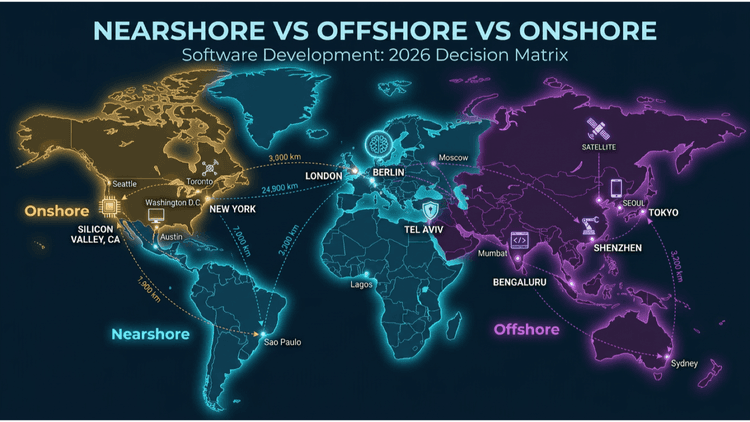
Nearshore vs Offshore vs Onshore Software Development: 2026 Decision Matrix
Outsourcing Software Development to Turkey: 2026 Buyer's Guide
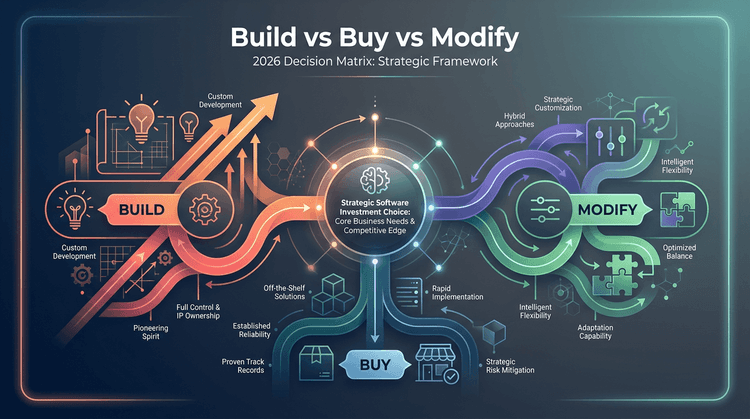
Build vs Buy vs Modify: The 2026 Decision Matrix for Software Investment
Software Discovery Phase: Why 2-4 Weeks Before the Build Are the Highest-ROI Weeks of Your Project (2026 CTO Guide)