
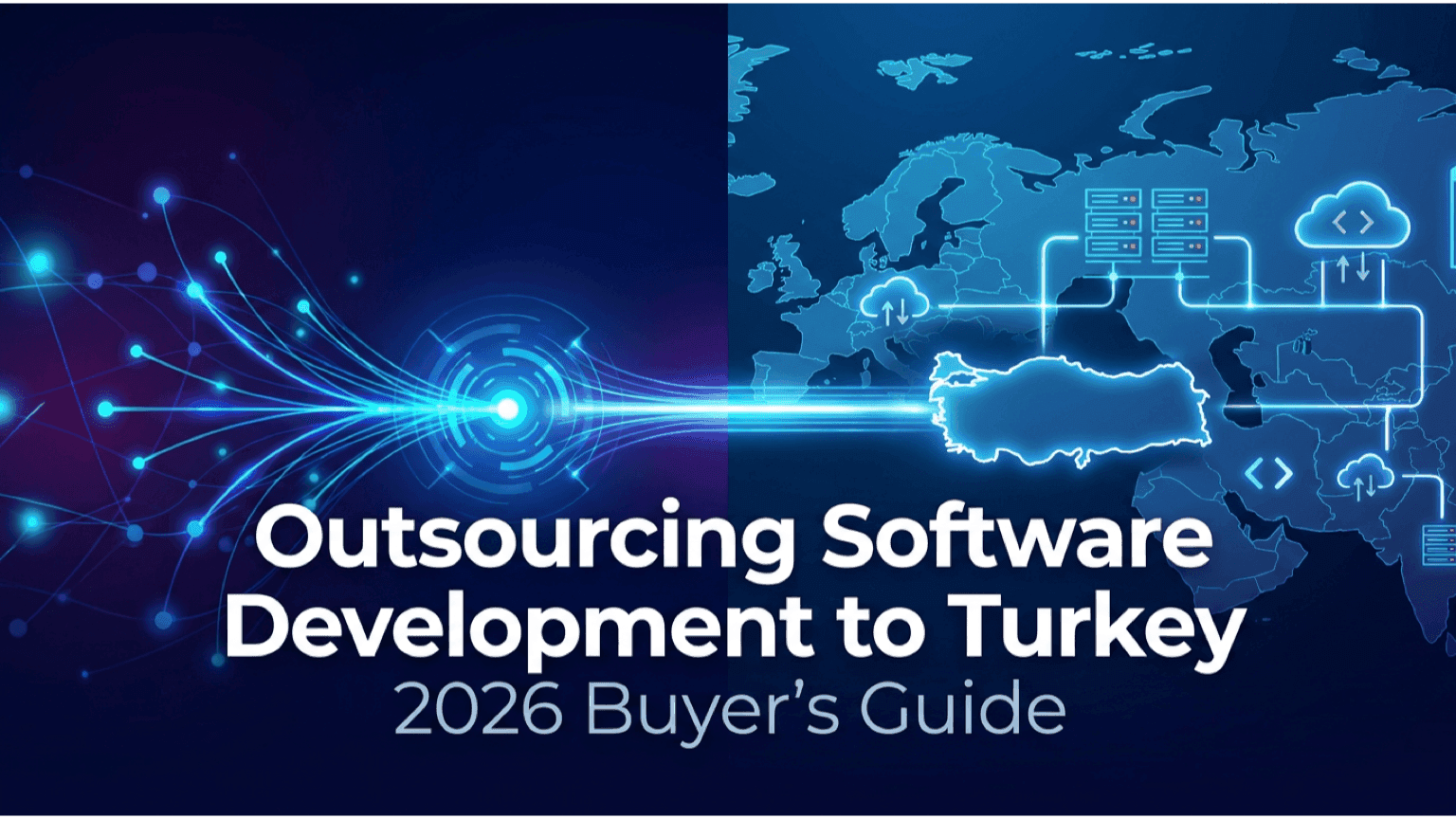
Outsourcing Software Development to Turkey: 2026 Buyer's Guide
Buyers comparing software outsourcing destinations in 2026 typically end up with a shortlist of four regions: India, Eastern Europe, Latin America, and Turkey. The fifth name on the list is usually internal hiring or a near-shore Western European studio.
Turkey is the destination most people misread. It sits at the EU border, runs on EU time zones, costs 40-60% less than UK/US senior engineering, and has a 250,000+ working software developer pool. Yet the buyer guides that surface in Google are mostly written by aggregator directories, not by the firms doing the work.
This guide covers Turkey's actual position in the global outsourcing market in 2026: where it wins, where it doesn't, what to ask during vendor selection, and how it compares to the alternatives a buyer is already considering.
Internative is a Turkish technology company. We've delivered 400+ projects to enterprise clients in Turkey, UK, EU and the US since 2017. This guide reflects what we see when international buyers walk through our door.
Why Turkey Shows Up on Outsourcing Shortlists in 2026
Four structural reasons make Turkey a competitive nearshore option for European buyers and a competitive offshore option for US buyers:
Time zone overlap. Turkey runs on UTC+3 year-round. That gives full overlap with EU working hours, partial overlap with UK afternoons, and a working morning window with US East Coast. Compared to India (UTC+5:30 with reversed working hours) or the Philippines (UTC+8), real-time collaboration is meaningfully easier.
Talent supply. Turkey graduates roughly 50,000 STEM engineers per year. There are an estimated 250,000-300,000 working software developers in the country. The local tech scene includes globally recognized companies (Getir, Hepsiburada, Insider, Trendyol, Peak) that have trained a generation of senior engineers.
Cost ratio. Senior engineering rates in Turkey sit at roughly 40-60% of comparable UK/US rates and 20-30% below Western European rates. Mid-level rates compare more aggressively. This is not the cheapest option globally (Vietnam and parts of South Asia are lower), but it sits at the favorable end of "developed enough quality at substantially lower cost."
EU-aligned regulatory frame. Turkey's data protection law (KVKK) is structured on the GDPR model, making EU client compliance discussions practical. SOC 2 and ISO 27001 are common among mid-size and larger firms.
Where Turkey Wins
B2B SaaS and custom enterprise platforms. The local SaaS ecosystem is mature. Turkish companies have built and sold B2B SaaS products to global markets (Insider, UserGuiding, Peak, Picus Security). The engineering culture for multi-tenant architecture, billing, role-based access, and global scaling is well-developed.
AI integration and applied machine learning. A wave of local AI investment (including Turkey's own LLMs like Kumru) has built strong applied AI capacity. Production AI deployments, router architectures, RAG systems and AI operations layers are common project types.
Mobile development. Turkish studios have shipped high-volume B2C mobile applications across banking, e-commerce and gaming. iOS and Android native teams are widely available.
Enterprise integration projects. Turkish firms have deep experience integrating with SAP, Oracle, Salesforce, Logo and Netsis. For European or US clients that need to bridge to legacy ERP environments, this is a useful capability.
Complex web applications. Modern stacks (React, Next.js, TypeScript, Node, Python, Go) are standard. Engineering quality at senior levels is competitive with Western European firms.
Where Turkey Doesn't Win
Pure design-first product studios. For projects where world-class consumer product design is the primary success driver, the strongest design talent is concentrated in San Francisco, London, Berlin and Stockholm.
Highly regulated US sectors. FDA-cleared medical device software, HIPAA-heavy healthcare implementations, FedRAMP, ITAR — these require deep US regulatory familiarity. Turkish firms can deliver the engineering, but the compliance work typically routes through a US partner.
Extremely large contract structures. Multi-hundred-million-dollar government IT contracts in the US and UK go to large local primes (Accenture, Deloitte, Capgemini). Turkish firms can be subcontractors but rarely the prime.
Very early-stage startup MVP work where co-location matters. If you need a CTO-in-the-room for 6 weeks and your investors expect that, Turkey adds friction.
How Turkey Compares to the Alternatives
Turkey vs. India
- Cost: India is cheaper at junior and mid levels. At senior level the gap narrows.
- Time zone: Turkey overlaps Western Europe and partially overlaps UK and US East. India does neither well.
- Quality variance: India has the deepest talent pool globally but the variance between firms is extreme. Turkey's talent pool is smaller, but the variance band is tighter.
- English fluency: Comparable at senior engineering levels.
- Choose India when: lowest cost matters most, large team scale is needed, time zone is acceptable.
- Choose Turkey when: EU working hours matter, quality consistency matters, mid-size project structure works.
Turkey vs. Latin America (Mexico, Brazil, Argentina)
- Cost: Latin America is similar at senior level, slightly higher in some countries.
- Time zone: Latin America wins for US clients (same-day overlap). Turkey wins for EU clients.
- English: Argentina and Brazil are improving; still typically below Turkey for senior engineering writing communication.
- Choose LatAm when: US time-zone alignment is the top priority.
- Choose Turkey when: EU alignment matters more, AI integration or enterprise complexity is central.
Turkey vs. Eastern Europe (Poland, Romania, Ukraine)
- Cost: Poland and Romania run 20-30% higher than Turkey. Ukraine was cheaper pre-war; post-war supply is constrained.
- Time zone: All comparable for EU.
- EU member benefit: Poland and Romania are EU members, simplifying contracts and data flow. Turkey is not an EU member but has GDPR-aligned KVKK.
- Cultural alignment: Polish and Romanian firms read more "Western European" in process and communication style. Turkish firms have a particular blend of EU-style process discipline and Mediterranean directness.
- Choose Eastern Europe when: EU member contracting is essential, budget allows the premium.
- Choose Turkey when: cost matters more, AI integration or B2B SaaS is the project, EU member status is not a contracting requirement.
Turkey vs. Western Europe (Germany, Netherlands, UK)
- Cost: Western Europe is 2-3x more expensive at senior level.
- Quality: Top Western European firms set the global ceiling. Turkey is competitive with mid-tier Western European firms.
- Choose Western Europe when: budget is unconstrained and absolute top-end quality matters.
- Choose Turkey when: 60-80% of that quality at half the price meets the business case (most cases).
Turkey vs. Internal Hiring
- Cost: Internal hiring is typically 1.5-2x the visible rate when fully loaded (recruiting, benefits, management, churn).
- Speed: Building an internal team takes 6-12 months. A Turkish vendor team can start in weeks.
- Strategic fit: Internal hiring wins when software is the company's core product and 5+ year horizon. Vendor wins for project-shaped work and faster execution.
What to Ask a Turkish Software Vendor Before Signing
Standard global vendor questions still apply (we published a 38-question checklist). Five questions are specifically worth asking Turkish vendors:
1. What's your data residency plan for our jurisdiction? Many EU clients require data stored in EU regions. Turkey's data centers and AWS/GCP/Azure Turkey regions exist, but most vendors will deploy to EU regions on request. Get the answer in writing.
2. How do you handle currency and contract terms? Most international contracts price in USD or EUR. Confirm currency, payment terms, and any local tax implications. Some Turkish firms operate through EU subsidiaries (Netherlands, Estonia, UK) for cleaner contracting; ask which entity is signing.
3. Will the team you put on this project be the same team in 12 months? Turkish engineering market is competitive locally. Senior engineer turnover at mid-size firms ranges 15-25% annually. Lock in key roles in the contract.
4. Do you have direct experience with our specific tooling and partner ecosystem? Salesforce, Stripe, Twilio, AWS — most Turkish firms know these. Less common stacks (Microsoft Dynamics, IBM, SAP S/4HANA specific modules) need explicit verification.
5. How do you handle KVKK/GDPR/HIPAA/SOC 2 evidence requests? If your buyer compliance team asks for SOC 2 reports, penetration testing logs, or data flow diagrams, can the vendor produce them within standard timelines? Smaller Turkish firms can be light on this.
How Internative Fits
Internative is one of several Turkish technology firms that international clients shortlist. Our positioning:
- Sweet spot: B2B SaaS, custom enterprise software, AI native products and AI integration, ERP-adjacent layers, mobile and web platforms.
- Project size: $200K-$2M typical project range.
- Team: 30-50 engineers, senior-heavy ratio.
- Own products: Koordex (AI operations layer) and Worktivity (productivity SaaS) — we run our own SaaS in production, which informs how we build client products.
- Geographic clients: Turkey-based, plus active clients in the UK, EU and US.
- Methodology: Discovery-first projects with phased contracts and code ownership transferred to the client.
We don't fit every project. We're not the cheapest option in the global market, we don't take on extremely large public-sector contracts, and we don't take on consumer-design-led product studios.
A Realistic First Step
If you're evaluating Turkey as an outsourcing destination, the lowest-friction first step is not a tender. It's a 30-minute call with two or three Turkish firms in your shortlist where you ask the five questions above and judge how the conversation runs.
The shortlist is typically built from:
- Referrals from companies already working with Turkish firms
- Clutch and similar directories (filtered for your specific use case)
- LinkedIn search for "[your domain] AND turkey software"
- Direct outreach to known names
A vendor that can answer pricing model, data residency, team stability, and compliance questions in a single 30-minute call probably scales to the rest of the engagement.
Related Reading
- How to Choose a Custom Software Development Company: 2026 Global CTO Guide
- Nearshore vs Offshore vs Onshore Software Development: 2026 Decision Matrix
- Enterprise Software Vendor Selection: 2026 CTO Checklist (38 Questions)
- Custom Software ROI Calculation Framework (2026)
For a deeper company-by-company shortlist of Istanbul and Turkey vendors, see the 2026 Istanbul & Turkey software companies buyer's guide.
Next Step
If you're scoping a project that could route through a Turkish vendor, we offer a 30-minute discovery call where we walk through your scope, fit, alternative options, and what a phased proposal would look like. No commitment, no sales pitch.
Contact: team@internative.net or via internative.net.
Related services
Where this topic becomes an engagement.
Keep reading
More articles from Blog.
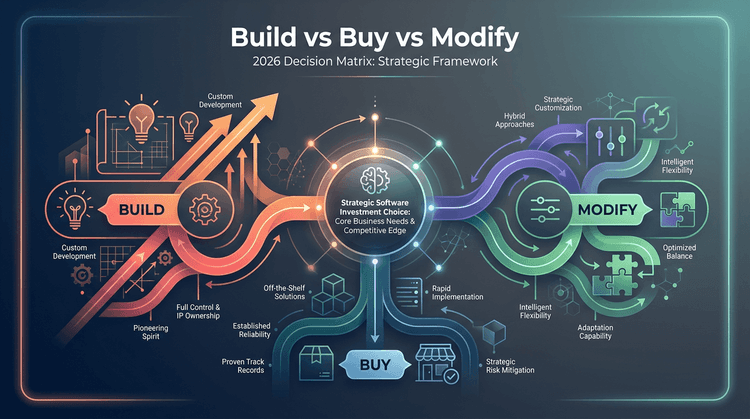
Build vs Buy vs Modify: The 2026 Decision Matrix for Software Investment
Software Discovery Phase: Why 2-4 Weeks Before the Build Are the Highest-ROI Weeks of Your Project (2026 CTO Guide)
Custom Software Pricing Models: Fixed Price vs T&M vs Outcome-Based (2026 Comparison)
The ROI of Custom Software: A 2026 Calculation Framework for CFOs and CTOs