
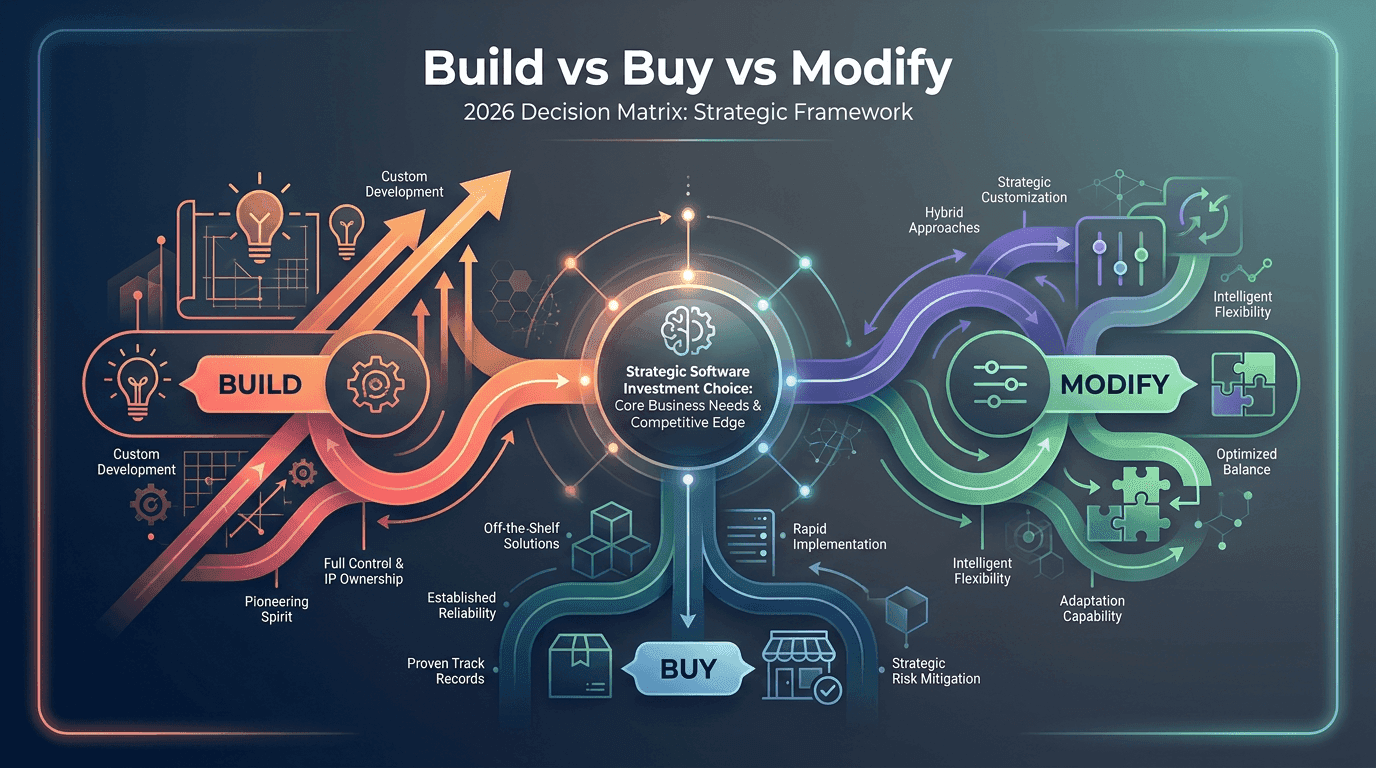
Build vs Buy vs Modify: The 2026 Decision Matrix for Software Investment
"Should we build this ourselves or buy a SaaS?"
The question is framed wrong. It is not a two-way choice. It is a three-way one:
Build: Custom software from scratch
Buy: Off-the-shelf SaaS or packaged software
Modify: Extending an existing platform, your own system, open source, or an extensible SaaS
Because most teams do not see the third option, they either build from scratch when they should not, wasting time and budget, or stay locked into SaaS when they should have built, losing control.
The right answer is not the same every time. This article compares all three options across real cost ranges, ownership, flexibility and risk. At the end, we give an 8-factor decision matrix and 4 hybrid strategies.
Distilled from our work since 2017, both projects we ran, the calls we made and the contracts we were brought in to rescue.
The 3 Options: Quick Comparison
Build, or Custom Software from Scratch
Typical duration:
6-18 months
Typical cost, 3-year TCO:
$200K-$2M
Control:
High
Flexibility:
High
Risk:
High, because you need to build and maintain it.
Buy, or Off-the-Shelf SaaS / Packaged Software
Typical duration:
2-12 weeks
Typical cost, 3-year TCO:
$20K-$500K
Control:
Low
Flexibility:
Low
Risk:
Low, but vendor risk remains.
Modify, or Extend an Existing Platform
Typical duration:
2-8 months
Typical cost, 3-year TCO:
$60K-$700K
Control:
Medium-high
Flexibility:
Medium-high
Risk:
Medium, because vendor and integration risks remain.
Option 1: Build, or Custom Software from Scratch
When It Is Right
The process is a strategic differentiator. This is where you need to be different from competitors.
Off-the-shelf solutions break your process. You keep building workarounds on top of SaaS.
Data ownership is critical. GDPR, industry regulation or proprietary analytics requirements make ownership necessary.
You are hitting a scale band change. SaaS per-seat pricing compounds as user count grows.
You have a 5+ year horizon. Long-term, costs tilt toward build.
When It Is Wrong
The process is standard and sector best practice exists. SaaS suffices, and build is over-engineering.
You need ROI in under 12 months. Build typically pays back at 9-14 months, which may be too slow.
Your internal team is not ready for build ownership. Vendor lock-in returns in a different mask.
The process is not mature yet. It is unclear what to build, so you are constructing on a moving target.
Real Cost, 3-Year TCO
Build:
$200K-$1.5M for a mid-size project
Maintenance:
15-25% of build cost per year
Iteration and scale:
30-50% of build cost in the first year of expansion
Total 3-year cost:
Build cost × 1.5-2.5
3 Conditions That De-Risk Build
Discovery on a separate contract. See our discovery guide.
Phase-gate contract. Exit rights at each phase boundary.
In-house tech lead. Someone who can independently evaluate code quality.
Option 2: Buy, or Off-the-Shelf SaaS / Packaged Software
When It Is Right
The process is standard. It is the same as sector best practice, not a differentiator.
You need rollout in under 6 months. This may be due to a market opportunity or urgent compliance need.
You have a small team, under 10 users. SaaS per-seat pricing stays low.
The vendor is stable and large enough. Ideally, it has 5+ years in market and an extensive integration ecosystem.
Data ownership is not critical. Analytics and reporting are sufficient as the SaaS provides them.
When It Is Wrong
The process is unique and different from competitors. That is build territory.
You have 50+ users. SaaS per-seat pricing climbs into $100K-$300K per year and can overtake build in 3 years.
Data ownership is a regulatory requirement.
The vendor controls product direction. Their roadmap, not yours, shapes the future.
You need 5+ integrations. SaaS APIs are insufficient, and the missing work is either built separately or paid for.
Real Cost, 3-Year TCO
Licensing:
Annual per-seat cost × user count × 3 years
Implementation:
Usually 30-100% of the license fee, including consultancy and integration
Customization:
Limited by what the SaaS allows, with extra modules billed separately
Migration cost:
Leaving SaaS means data export and reimplementation, usually 1.5-3x the initial cost
The Biggest Mistake
Most companies look at the license cost of SaaS and skip the total cost of ownership, or TCO.
The 36-month TCO is usually 2-3x the license cost.
Our ROI framework has the detailed math.
Option 3: Modify, or Extend an Existing Platform
This is the most skipped option and, for many enterprise projects, the most correct one.
3 Sub-Types
3a. Customize an Open Source Platform
Examples include Strapi, n8n, Odoo and WooCommerce.
Core features are ready, and custom logic is built on top.
Code ownership stays with you, with no vendor lock-in.
Community and module ecosystem are available.
3b. Extend an Extensible SaaS via API or SDK
Examples include Shopify Plus, Salesforce and Zendesk.
SaaS handles the core, and custom logic builds on top.
You pay per seat, but the custom layer is your code.
Vendor direction change remains a risk.
3c. Modernize or Extend Your Existing In-House System
This means legacy system plus new modules, often using a microservice strangler pattern.
The domain is known.
The users are known.
The risk is that modernization failure rate is 40%+ without discovery and good planning.
When It Is Right
The existing system still does its core job well, but some modules are missing or old.
Open source or extensible SaaS handles 70-80% of sector needs, and 20-30% custom work is required.
You have a 6-12 month ROI window, too short for build and too constrained for buy.
Your internal team can own modify with less staffing than build.
When It Is Wrong
The existing system is not differentiating and maintenance is expensive. Modify becomes wasted time.
Open source or extensible SaaS handles less than 50% of needs. Build is more correct.
Vendor or platform direction change is coming, such as a Salesforce major upgrade. The modify cycle restarts.
Real Cost, 3-Year TCO
Initial modify:
$50K-$400K, usually 30-50% of build cost
Vendor or platform license:
Annual cost. For open source, it may be $0. For extensible SaaS, it may be $1K-$10K per month. For in-house systems, it is your own.
Maintenance:
10-20% of modify cost per year
Total 3-year cost:
Modify cost × 1.3-1.8
For most enterprise projects, the lowest 3-year TCO is modify.
Because the core is ready, you only build the differentiating layer.
8-Factor Decision Matrix
Score each option on 8 factors using a 1-5 scale.
The highest total wins.
1. Process Differentiation
Question:
Is the process competitively different?
Build fit:
High differentiation makes build stronger.
Buy fit:
Low differentiation makes buy stronger.
Modify fit:
Medium differentiation makes modify stronger.
2. Time-to-Value
Question:
How fast do you need it?
Build fit:
6-18 months
Buy fit:
2-12 weeks
Modify fit:
2-8 months
3. 3-Year TCO
Question:
What is your budget ceiling?
Build fit:
High upfront cost, stronger long-term ownership.
Buy fit:
Low upfront cost, but long-term license cost can grow.
Modify fit:
Medium cost, often the best balance.
4. Data Ownership Need
Question:
Do GDPR, regulation or analytics requirements make data ownership important?
Build fit:
High ownership need points to build.
Buy fit:
Low ownership need points to buy.
Modify fit:
Medium-high ownership need can point to modify.
5. Scale Uncertainty
Question:
How many users will you have in 5 years?
Build fit:
Ownership helps as scale grows.
Buy fit:
Per-seat pricing may become a headache.
Modify fit:
A hybrid structure can reduce scale risk.
6. Internal Team Capacity
Question:
Can your team own the build?
Build fit:
High internal capacity supports build.
Buy fit:
Low internal capacity supports buy.
Modify fit:
Medium internal capacity supports modify.
7. Vendor Lock-In Tolerance
Question:
What switching cost is acceptable?
Build fit:
Low tolerance for lock-in supports build.
Buy fit:
High tolerance can support buy.
Modify fit:
Medium tolerance can support modify.
8. Process Maturity
Question:
Does the process know what to build?
Build fit:
Mature process supports build.
Buy fit:
Mature standard process supports buy.
Modify fit:
Mature partial-fit process supports modify.
Score each factor 1-5 for each option.
Sum the totals.
The highest score wins.
If the scores are close, use a hybrid strategy.
4 Hybrid Strategies
Hybrid 1: Buy + Modify
Core SaaS plus custom layer.
Use SaaS for standard work, such as CRM and accounting.
Build a custom layer on the SaaS API for differentiating work.
Example:
An off-the-shelf CRM plus a custom pipeline automation layer built on top.
Hybrid 2: Modify + Build
Open source platform plus new modules.
Use open source for the core function, such as Strapi, Odoo or n8n.
Build new modules from scratch.
Example:
Odoo ERP plus custom industry-specific modules.
Hybrid 3: Build Phase 1 + Buy Phase 2
Build the first MVP to validate.
After validation, either continue or migrate to off-the-shelf software.
Example:
Build MVP, then migrate to Salesforce after user feedback.
Hybrid 4: Buy + Eventually Build
Start with SaaS, then build when scale hits.
Switch point:
Per-seat cost × user count exceeds $150K per year.
Example:
Shopify plus Shopify Plus, then eventually custom checkout when the team reaches 50+.
3 Common Mistakes in the Decision
1. You Make the Build Call on “I Want Control”
“It should all be ours” is an emotional driver, not an objective one.
If data ownership is not a regulatory requirement and the process is not differentiating, build is an expensive illusion of control.
2. You Make the Buy Call on “It Looks Fast and Cheap”
License price is visible.
TCO is not.
After 36 months, license, implementation and migration cost can exceed build.
Our ROI framework has the math.
3. You Never Consider Modify
The “Build vs Buy” binary is a 1990s frame.
By 2026, open source and extensible SaaS ecosystems have matured to the point that modify is the right answer for most projects.
Next Step
This decision is made together with pricing model, vendor selection and discovery.
Related reading:
Custom Software vs SaaS: 9-Question Decision Framework
Custom Software Pricing Models: Fixed Price vs T&M vs Outcome-Based 2026
Software Discovery Phase: Why the 2-4 Weeks Before the Build Matter Most
Enterprise Software Vendor Selection: 2026 CTO Checklist
Custom Software ROI Calculation Framework 2026
Related services
Where this topic becomes an engagement.
Keep reading
More articles from Blog.
Software Discovery Phase: Why 2-4 Weeks Before the Build Are the Highest-ROI Weeks of Your Project (2026 CTO Guide)
Custom Software Pricing Models: Fixed Price vs T&M vs Outcome-Based (2026 Comparison)
The ROI of Custom Software: A 2026 Calculation Framework for CFOs and CTOs

Software Graveyard — 5 Signs and 4 Decisions for Rescuing a Stalled Project