
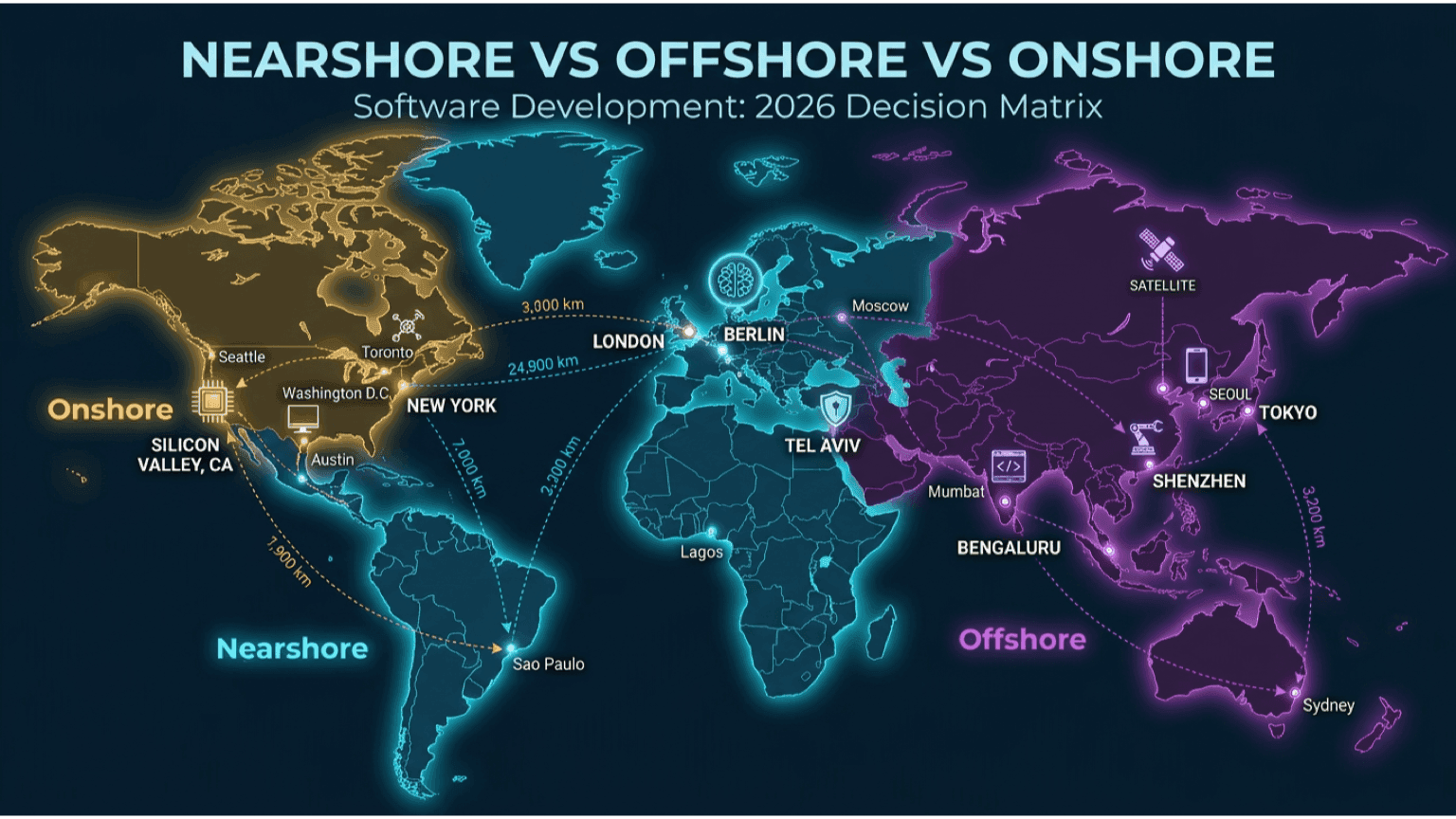
Nearshore vs Offshore vs Onshore Software Development: 2026 Decision Matrix
The choice between onshore, nearshore, and offshore software development used to be primarily a cost discussion. In 2026 it's a strategic choice that affects velocity, communication overhead, compliance posture, and the kind of work that's actually possible.
This article is the decision matrix we wish every CTO had before sending their first RFP. Sixteen years of running projects across all three models, including current work with US, UK, EU and Turkish clients.
It covers what each model actually means in 2026, where each wins, where each fails, and the 8-factor matrix that resolves the choice.
Definitions That Are Already Out of Date
The classic definitions are losing precision:
- Onshore: vendor in the same country as the client.
- Nearshore: vendor in a country with significant time-zone overlap (1-3 hours).
- Offshore: vendor in a country with limited or reversed time-zone overlap.
The classic split is fine for geography, but the categories no longer predict outcomes the way they used to. In 2026 three shifts matter:
One. Remote-first work normalized cross-border collaboration. A "nearshore" vendor in Poland and an "offshore" vendor in Vietnam can deliver the same project velocity if both run on the same agile process and the offshore team works with reasonable hour overlap.
Two. Cost gaps between locations shrunk. Senior engineers in Poland, Mexico and Turkey now cost roughly the same. The "offshore = cheapest" assumption fails.
Three. Quality variance within each region is now larger than the variance between regions. A top-tier Vietnamese firm can outperform a mid-tier Polish firm.
The decision is no longer "onshore/nearshore/offshore." It's "which specific vendor profile in which specific region for which specific project."
Onshore — What It Actually Looks Like in 2026
Examples: US clients hiring US-based studios (10up, Coalition, Hashrocket); UK clients hiring UK studios (Made Tech, Equal Experts); German clients hiring German studios.
Where Onshore Wins
- Highest design-led work: consumer products where the design quality is the product
- Defense, government, FedRAMP, ITAR: regulatory requirements that effectively prevent foreign vendors
- Co-location requirement projects: 6-week MVP sprints where the team is in the room with the client
- Senior consulting + design partnership: when the project needs world-class strategic input as much as engineering
Where Onshore Loses
- Cost: senior engineering 2-4x the offshore equivalent
- Speed of staffing: top studios are booked 6-18 months out
- Project scale: most onshore studios can't take on $2M+ engagements without subcontracting anyway
Typical Cost Range (2026)
- US studios: $150-$300/hour for senior engineers
- UK studios: £100-£200/hour
- German studios: €110-€200/hour
Nearshore — What It Actually Looks Like in 2026
Examples: US clients working with Mexico, Costa Rica, Colombia, Argentina. EU clients working with Poland, Romania, Bulgaria, Turkey, Portugal.
Where Nearshore Wins
- EU and US time-zone overlap: real-time daily standups, faster decisions
- Cultural proximity: less misalignment on what "done" means
- Senior engineering capacity at 40-60% of onshore cost
- Sufficient for most enterprise project types
Where Nearshore Loses
- Not the absolute cheapest: offshore can be 30-50% lower at junior/mid levels
- Talent pool variance: smaller markets than India or Vietnam, harder to scale large teams quickly
- EU member benefits: vendors outside EU (Turkey, UK post-Brexit) add contract complexity for EU buyers
Typical Cost Range (2026)
- Mexico, Costa Rica: $50-$120/hour
- Poland, Romania: €50-€100/hour
- Turkey: $40-$90/hour
- Portugal: €60-€110/hour
Offshore — What It Actually Looks Like in 2026
Examples: US/UK/EU clients working with India, Vietnam, Philippines, Indonesia, Pakistan.
Where Offshore Wins
- Lowest cost at junior/mid levels: 30-50% below nearshore
- Talent scale: India alone has 4-5 million working software developers
- 24/7 operational coverage: time-zone gap can be turned into a feature for ops/support
- Mature outsourcing ecosystem: standard contracts, established firms, vendor maturity
Where Offshore Loses
- Time-zone friction: real-time collaboration is structurally harder
- Quality variance: extreme, from world-class to unusable
- Process overhead: more PM layers needed to bridge the gap
- Senior engineer rates close to nearshore: cost savings concentrated at junior levels
Typical Cost Range (2026)
- India: $25-$80/hour (huge spread)
- Vietnam: $25-$70/hour
- Philippines: $30-$70/hour
8-Factor Decision Matrix
Score each model on 8 factors (1-5 scale). Highest total wins.
Factor | Onshore | Nearshore | Offshore
Time-zone overlap | 5 | 4 | 2
Cost per engineer | 1 | 3 | 5
Quality consistency | 4 | 4 | 3
Speed to staff | 2 | 4 | 4
Cultural alignment | 5 | 4 | 3
Compliance fit (your country) | 5 | 3 | 2
Talent pool scale | 3 | 3 | 5
Communication overhead | 5 | 4 | 2
Total possible: 40. Realistic ranges:
- Onshore: 28-32 — wins on quality and overlap, loses on cost
- Nearshore: 28-32 — balanced, wins on net for most projects
- Offshore: 24-28 — wins on cost and scale, loses on collaboration
When totals are close (within 2-3 points), the decision should fall to specific project characteristics, not the category total.
Project-Type Matchups
Project Type | Best Fit
Consumer product, design-led | Onshore
Government, defense, regulated US | Onshore
B2B SaaS, mid-market | Nearshore
Custom enterprise software, EU client | Nearshore (EU member preferred)
Custom enterprise software, US client | Nearshore (LatAm)
AI integration, AI native products | Nearshore (where AI talent is concentrated)
Mobile B2C high-volume | Nearshore or top-tier offshore
Large-scale junior-heavy work | Offshore
24/7 ops, support, QA | Offshore (time-zone advantage)
Legacy modernization, mid-budget | Nearshore
Specialized AI research | Onshore (US) or nearshore (EU AI hubs)
Hybrid Models — What Most Mature Buyers Actually Run in 2026
The "pick one location" framing is dated. Most mid-size and larger buyers run hybrid models:
Hybrid 1: Onshore architect + nearshore delivery A senior architect in your country owns the design and client-facing communication. The build team is nearshore. Common in EU and US mid-market.
Hybrid 2: Nearshore primary + offshore augmentation Core team nearshore for collaboration quality. Offshore added for specific roles where cost matters (QA, junior dev, ops). Common at scale.
Hybrid 3: Offshore + onshore PM Cost-driven build offshore, but a senior PM in your country handles client relationship and quality gates. Older model, still common in cost-sensitive sectors.
Hybrid 4: Multi-region distributed team No single "vendor location." Team picked by talent, not geography. Increasingly common for high-end product teams.
The Three Mistakes Buyers Make
Mistake 1: Picking the model before scoping the project. "We want offshore because budget" is backwards. Scope first, then pick the model that fits. A $200K project might be better off onshore with a small team than offshore at scale.
Mistake 2: Treating "nearshore" or "offshore" as a quality signal. Region tells you nothing about specific vendor quality. The top firm in any region beats the bottom firm in any other region.
Mistake 3: Optimizing on hourly rate instead of total cost of project. Junior offshore at $30/hour with 30% rework lands at $40-50/hour effective rate. Senior nearshore at $80/hour with low rework lands at $80/hour effective. Compare total cost, not unit cost.
Five Questions That Resolve the Choice
- What's the project size in total cost? Under $200K — onshore studios usually too expensive. $200K-$2M — sweet spot for nearshore. $2M+ — depends on team scale, often hybrid.
- What's the time-zone tolerance? If real-time collaboration is non-negotiable, eliminate offshore. If async is acceptable, all three are open.
- What regulatory frame applies? US government work → onshore mandatory. EU GDPR-heavy → nearshore EU member preferred. KVKK/GDPR-aligned → Turkey, EU nearshore work.
- What's the timeline? Fast start (under 4 weeks) → eliminate onshore in most cases. 6+ month projects with measured ramp → all three open.
- What kind of talent are you actually buying? Design-led → onshore. AI integration engineering → nearshore. Volume engineering → offshore.
Related Reading
- Outsourcing Software Development to Turkey: 2026 Buyer's Guide
- Enterprise Software Vendor Selection: 2026 CTO Checklist (38 Questions)
- Custom Software Pricing Models: Fixed Price vs T&M vs Outcome-Based (2026)
- Build vs Buy vs Modify: 2026 Decision Matrix
Next Step
If you're shortlisting vendors across regions and want a second opinion on fit, we run 30-minute strategy calls where we look at your scope and tell you honestly which region makes sense and what tradeoffs you'd be making.
Contact: team@internative.net or via internative.net.
Related services
Where this topic becomes an engagement.
Keep reading
More articles from Blog.

Outsourcing Software Development to Turkey: 2026 Buyer's Guide
Build vs Buy vs Modify: The 2026 Decision Matrix for Software Investment

Software Discovery Phase: Why 2-4 Weeks Before the Build Are the Highest-ROI Weeks of Your Project (2026 CTO Guide)
Custom Software Pricing Models: Fixed Price vs T&M vs Outcome-Based (2026 Comparison)