AI Consulting Services in 2026: 8 Categories, Pricing Ranges, and the Buyer Decision Matrix
"We need help with AI" sits on too many CTO desks as a single line item in next year's budget.
The honest answer is that "AI consulting services" in 2026 is not one thing. It's 8 distinct service categories with different deliverables, different vendors, different price ranges, and different success patterns. Buying the wrong category for your stage is the most expensive mistake in this market.
This article is the buyer's overview of those 8 categories: what each delivers, when to buy it, who the right vendor type is, what it costs, and the decision matrix that resolves the choice.
We've delivered all 8 categories through Koordex (our AI operations layer) and Internative's AI Studio service over the last 24 months. The price ranges and patterns here are from real client deployments.
The Big Picture
The "AI consulting services" category covers everything from a one-hour strategy call to a multi-year enterprise transformation. The 8 categories below are the discrete buying units. Mature buyers in 2026 typically purchase 3-5 of these in sequence, not all at once.
The right sequence:
- Strategy / readiness
- Architecture
- MVP build
- Production hardening
- Ops layer
- Optimization and scale
Reverse engineering this — buying production hardening before you have a working MVP — is the most common waste pattern.
Category 1: AI Strategy Consulting
What it delivers: A 90-day AI strategy covering readiness, use case selection, architecture decisions, budget, governance, and a 12-month execution plan.
When to buy: You're moving from "we should do AI" to "we're shipping AI." You need executive alignment and board approval before spending build budgets.
Vendor type: Big-4 for board cover; specialist GenAI firm for execution focus; top-tier independent advisors for opinionated strategy.
Price range: $30K-$300K depending on scope and firm tier.
Output: Written strategy document, prioritized use case list with ROI estimates, recommended architecture per use case, team and budget plan, governance framework.
Success pattern: Strategy connects to specific use cases with named business owners. Strategy that's not tied to concrete use cases becomes shelfware.
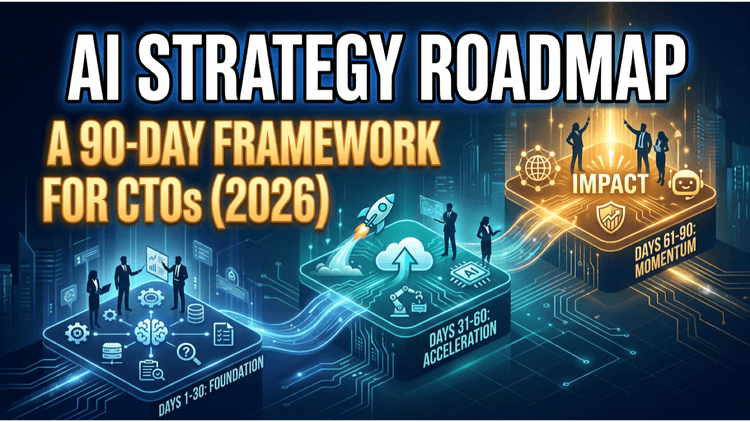
Related: AI Strategy Roadmap: 90-Day Framework for CTOs
Category 2: AI Readiness Assessment
What it delivers: A structured audit of data, process, people, culture, and infrastructure readiness for AI deployment.
When to buy: Before strategy. Skipping this means writing strategy on top of unknown foundations.
Vendor type: Specialist GenAI firms, Big-4 audit-style firms, independent advisors with deployment experience.
Price range: $20K-$80K.
Output: Readiness score per dimension (typically 5 dimensions, 28+ questions), top 3-5 weakest factors, prioritized remediation list.
Success pattern: The readiness gaps are addressed before strategy locks in commitments. Companies that hide readiness gaps from leadership pay for them in year 2.
Category 3: AI Architecture Consulting
What it delivers: Technical architecture for specific use cases — RAG vs fine-tuning vs prompt engineering, multi-agent patterns, data plane, model strategy, tool exposure (MCP), observability stack.
When to buy: After use case selection, before build commitment.
Vendor type: Specialist GenAI firms (Type 3 from our consulting firms guide) — Big-4 generally lacks the depth here unless engaging a specialist subteam.
Price range: $30K-$150K per use case.
Output: Architecture decision document, technical spec, risk registry, build estimate.
Success pattern: Architecture is locked in writing before build sprint 1. Architecture that "emerges during build" produces rework and missed budgets.
Related: RAG vs Fine-tuning vs Prompt Engineering (2026)
Category 4: AI Implementation Consulting (MVP Build)
What it delivers: A working AI feature shipped to production. Typically a 6-12 week build cycle following architecture and discovery.
When to buy: After architecture decisions are locked, with a specific use case and named business owner.
Vendor type: GenAI specialist firm with engineering depth. Big-4 typically subcontracts this work.
Price range: $80K-$600K per use case.
Output: Production-deployed feature, technical documentation, runbook, monitoring, handover plan.
Success pattern: MVP defined as "shipped to real users, measured against KPI, learnings documented." MVP defined as "internal demo" rarely converts to scale.
Category 5: AI Production Hardening
What it delivers: Taking a working MVP from "works for happy-path" to "works for 95% of users at scale." Covers observability, monitoring, guardrails, fallback paths, cost controls, security review.
When to buy: After 30-90 days of MVP usage with real users.
Vendor type: Same firm that built the MVP, OR a specialist AI ops firm if the original builder lacks production experience.
Price range: $50K-$300K.
Output: Hardened production system, monitoring dashboard, on-call runbook, cost optimization plan, security review report.
Success pattern: Hardening starts BEFORE the system fails publicly. Buyers who wait for the first major incident learn the lesson the expensive way.
Category 6: AI Ops Layer (Platform Engineering)
What it delivers: A layer that sits across multiple AI features — model routing, prompt management, observability, evaluation framework, cost tracking, governance, vendor abstraction.
When to buy: When you have 3+ AI features in production and they're costing more or breaking more than expected.
Vendor type: Specialist AI ops firms (Koordex category), platform-engineering-experienced GenAI firms.
Price range: $100K-$800K for initial build, then ongoing.
Output: AI ops platform deployed, governance framework operational, cost dashboard live.
Success pattern: Pays for itself in 6-12 months through cost reduction (router patterns alone cut 30-50% per LLM Cost Optimization) and prevented incidents.
Category 7: AI Optimization & Cost Engineering
What it delivers: Reducing the LLM and infrastructure bill without losing quality. Covers model routing, prompt compression, caching, semantic deduplication, right-sizing outputs, fine-tuning math.
When to buy: When monthly AI spend exceeds $20-50K and is climbing.
Vendor type: Specialist AI ops firms, FinOps consultants with AI experience.
Price range: $20K-$80K for a one-time optimization sprint; ongoing engagement $5-20K/month.
Output: Cost reduction plan, implemented optimizations, monitoring dashboard, savings tracked.
Success pattern: Typical engagement cuts bill 30-50% and pays for itself within 2-3 months. Documented sequence on LLM Cost Optimization: 7 Patterns.
Category 8: AI Change Management & Adoption
What it delivers: Driving actual usage and value capture from AI features. Covers training, documentation, internal champions, success metrics, organizational change.
When to buy: When AI features are shipped but not being used, or are being used but not creating measurable value.
Vendor type: Big-4 change management arms, organizational consulting firms, specialist boutiques.
Price range: $50K-$400K depending on org size and change scope.
Output: Training programs, adoption metrics, internal documentation, champion network.
Success pattern: The most underestimated category in 2026. AI deployments fail at adoption more often than at engineering.
The Comparison Table
# | Service | Typical Spend | Engagement Time | Vendor Type
1 | Strategy | $30-300K | 6-12 wks | Big-4 or specialist
2 | Readiness | $20-80K | 4-6 wks | Specialist
3 | Architecture | $30-150K | 4-8 wks | GenAI specialist
4 | MVP Build | $80-600K | 6-12 wks | GenAI specialist
5 | Production Hardening | $50-300K | 4-8 wks | Same builder or AI ops
6 | AI Ops Layer | $100-800K | 12-24 wks | AI ops specialist
7 | Cost Optimization | $20-80K | 3-6 wks | AI ops / FinOps
8 | Change Management | $50-400K | 12-26 wks | Big-4 or specialist
The Buyer Decision Matrix
Which category to buy first depends on where you are.
Where you are | First service to buy
"We should do AI" | Strategy + Readiness
Strategy approved, picking use cases | Architecture
Architecture locked, ready to build | MVP Build
MVP shipped, scaling | Production Hardening
3+ AI features in production | AI Ops Layer
Bill climbing, no governance | Cost Optimization
Built but no one uses it | Change Management
The mistake: trying to buy categories 4-7 before completing categories 1-3. Building before strategy and architecture is how the $500K MVP becomes a $3M rebuild.
Pricing Reality vs Marketing Pricing
What vendors quote vs what you actually pay:
- Quoted strategy engagement: $50K. Actual: $50K + $20K discovery + $10K extras = $80K.
- Quoted MVP build: $200K. Actual: $200K + $40K hardening + $30K monitoring + $20K training = $290K.
- Quoted AI ops platform: $300K. Actual: $300K + ongoing $5-15K/month support = $360-500K/year.
Build a contingency of 20-40% on every quoted price. The vendors that quote the lowest often have the largest gap to actual delivered cost.
What "Internative AI Consulting Services" Looks Like
We deliver categories 2-7 directly. We refer category 1 (pure strategy) to opinionated independent advisors and category 8 (change management) to specialist firms.
Stack we ship on:
- LangGraph, AutoGen, custom orchestration for agent patterns
- OpenAI, Anthropic, Google, Mistral via router architecture
- Pinecone, Weaviate, pgvector for RAG
- MCP for tool exposure
- LangSmith, Arize for observability
- Koordex as the AI ops layer across all the above
Stage we fit:
- Mid-market and enterprise B2B SaaS
- Regulated industries (financial, health, government) when paired with our compliance partner
- Companies at the inflection point: "we have one AI feature working, what's next?"
The Three Common Mistakes
Mistake 1: Buying out of order. The expensive failure pattern: buying MVP build (Category 4) before strategy and architecture (1-3) are done. Build cost balloons 2-3x.
Mistake 2: Buying everything at once. A "comprehensive AI transformation" RFP that bundles all 8 categories produces a generic proposal from a generalist vendor. Buy categories in sequence with separate decision gates.
Mistake 3: Underestimating change management (Category 8). The most common pattern of "we shipped AI but nothing changed." The technology shipped fine. The organization didn't change to use it. Plan and budget for this from the start.
Five Questions That Resolve the First Move
- Do you have a written AI strategy with named business owners per use case? No — start with Category 1.
- Have you done a structured readiness audit? No — start with Category 2.
- Do you have architecture decisions in writing for your top 2-3 use cases? No — start with Category 3.
- Is there a feature in production that 1000+ users touch? No — your current bottleneck is MVP (Category 4). Yes — your bottleneck is probably hardening (Category 5) or ops (Category 6).
- What's your monthly AI bill? Under $5K — focus on building, not optimizing. Over $30K with no governance — Category 7 (Cost Optimization) is your highest-ROI move.
Related Reading
- AI Strategy Roadmap: A 90-Day Framework for CTOs (2026)
- AI Consulting Firms 2026: 5 Vendor Types + Selection Framework
- RAG vs Fine-tuning vs Prompt Engineering (2026)
- LLM Cost Optimization: 7 Patterns (2026)
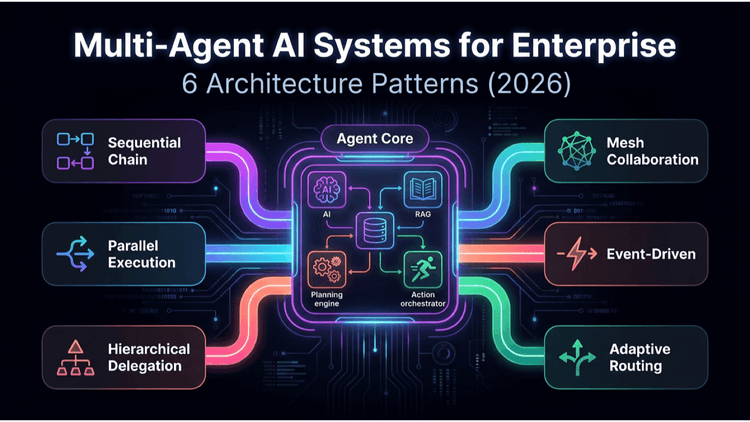
- Multi-Agent AI Systems: 6 Architecture Patterns (2026)
- AI Readiness Assessment: 28-Question Framework (2026)
- AI Implementation Consulting: 90-Day MVP Path (2026)
Next Step
If you're scoping an AI consulting engagement and unsure which category fits, we run 30-minute structured calls where we look at your specific situation and recommend the right service sequence.
Contact: team@internative.net or via internative.net.
Related services
Where this topic becomes an engagement.
Keep reading
More articles from Blog.