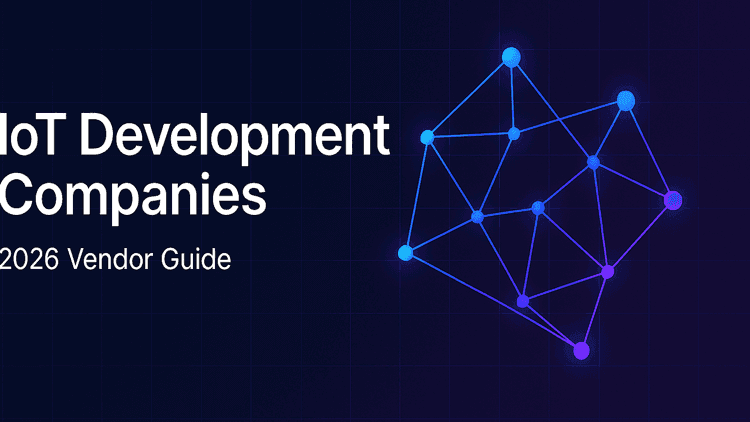
IoT Development Companies: 2026 Industrial vs Consumer IoT Vendor Guide
The IoT market split into two worlds in 2024 and the gap has only widened since.
On one side: industrial IoT — predictive maintenance, factory floor automation, energy management, fleet telemetry. Real ROI, mature buyers, long sales cycles, deep engineering requirements.
On the other side: consumer IoT — smart home, wearables, connected appliances. Hardware-design-heavy, price-sensitive, fast-moving.
Picking an IoT development company for one side that built only the other side is the most common buyer mistake in 2026. The architecture, the certifications, the connectivity choices, even the code review practices differ significantly.
This guide is the 2026 buyer's framework for picking an IoT development partner. Split by industrial vs consumer, 12 firms across vendor profiles, the 7-dimension scorecard, and 6 resolving questions.
Internative has shipped industrial IoT integrations through our Koordex AI operations layer and connected hardware projects through our IoT Studio service. The framework here comes from production work.
Industrial IoT vs Consumer IoT: The Practical Differences
Industrial IoT
- Buyer: plant manager, COO, operations director, maintenance engineering
- Outcome: measurable cost reduction (energy, downtime, manual labor), uptime improvements
- Hardware: ruggedized sensors, PLCs, edge gateways (industrial-grade)
- Connectivity: LoRaWAN, NB-IoT, cellular, ethernet, MQTT, OPC-UA
- Standards: ISA-95, ISA-99, IEC 62443 for security
- Compliance: functional safety (IEC 61508), industry-specific (FDA for pharma, NERC CIP for utilities)
- Volume: lower (10s-1000s of devices), high revenue per device
- Sales cycle: 6-18 months
- Project size: $300K-$5M+
Consumer IoT
- Buyer: product manager at consumer brand, hardware startup founder
- Outcome: consumer experience, mobile app polish, brand value
- Hardware: custom PCBs, low-power MCUs (ESP32, nRF52, STM32)
- Connectivity: WiFi, BLE, Thread, Matter (2026 dominant), occasional cellular
- Standards: Matter, Apple HomeKit, Google Home compatibility
- Compliance: FCC, CE, country-specific telecom regulations
- Volume: higher (10K-1M+ devices), lower revenue per device
- Sales cycle: 3-9 months
- Project size: $150K-$2M
A firm that has shipped 5 industrial IoT projects but no consumer IoT will struggle with WiFi-onboarding UX, BLE pairing flow, Matter compatibility, and Apple Made for iPhone (MFi) certification. The reverse is also true: consumer IoT firms typically lack PLC integration, OPC-UA fluency, and functional safety experience.
The 4 IoT Vendor Profiles
Profile 1: Industrial IoT Specialists
- Examples: Globalsign IoT, Hitachi Vantara, Aricent, Telit Cinterion partners
- Best for: factories, utilities, oil/gas, healthcare equipment, fleet management
- Strength: protocols (Modbus, OPC-UA, BACnet), edge computing, OT/IT integration
- Price: $120-250/hour, $500K-$5M+
Profile 2: Consumer IoT Specialists
- Examples: Toptal IoT teams, Saritasa, Eleks (consumer division), various hardware design houses
- Best for: connected consumer products, wearables, smart home, retail IoT
- Strength: hardware design, BLE/WiFi/Matter, mobile app, manufacturing partnerships
- Price: $80-180/hour, $200K-$2M
Profile 3: Hybrid Software + Hardware Firms
- Examples: Internative (via partner network), Innopolis Tech Solutions, certain regional integrators
- Best for: mid-market hybrid projects (industrial product with consumer-grade UX, or consumer product with industrial-grade reliability)
- Strength: full-stack from firmware to cloud to mobile, balanced cost
- Price: $80-180/hour, $300K-$2M
Profile 4: Large System Integrators
- Examples: Accenture IoT, Wipro, TCS IoT, Cognizant IoT
- Best for: enterprise IoT programs, multi-region rollouts, transformation projects
- Strength: scale, certifications, vendor partnerships (AWS IoT, Azure IoT, Google IoT)
- Price: $150-300/hour, $1M-$15M
12 IoT Development Companies Worth Knowing
# | Firm | Profile | Industrial vs Consumer | Region
1 | Hitachi Vantara | Industrial specialist | Industrial | Global
2 | Aricent (Capgemini) | Industrial specialist | Industrial | Global
3 | Telit Cinterion | Industrial connectivity | Industrial | Global
4 | Saritasa | Consumer specialist | Consumer | US
5 | ScienceSoft | Hybrid | Both | US/EU
6 | Eleks | Hybrid | Both | EU
7 | Cognizant IoT | System integrator | Both | Global
8 | Accenture IoT | System integrator | Both | Global
9 | AWS Professional Services (IoT) | Cloud hyperscaler | Both | Global
10 | Microsoft Azure IoT partners | Cloud hyperscaler | Both | Global
11 | Internative (IoT Studio) | Hybrid software | Industrial-leaning | Turkey/EU
12 | Top independent operators | Boutique | Varies | Global
For 2026 IoT builds, the practical shortlist depends entirely on industrial vs consumer split, plus your existing cloud commitment.
What Is an IoT Development Company?
A firm that designs, builds, and operates Internet of Things systems for customers. The full stack:
- Hardware design (PCB, MCU selection, antenna, power management)
- Firmware (RTOS, embedded C/C++, Rust embedded)
- Connectivity (BLE, WiFi, Matter, LoRaWAN, NB-IoT, cellular)
- Cloud infrastructure (AWS IoT Core, Azure IoT Hub, Google IoT Core, ThingsBoard)
- Mobile and web apps (React Native, Flutter, native iOS/Android, web dashboards)
- Data pipeline (time-series databases, streaming analytics, ML for predictive maintenance)
- Security (device identity, firmware OTA security, encryption, certificate management)
A vendor that only does 2-3 of these layers and outsources the rest is a reseller, not a full IoT development company.
The 2026 IoT Stack
For industrial IoT in 2026:
- Edge compute: Raspberry Pi (low-cost), NVIDIA Jetson (AI at edge), industrial Linux (Ubuntu Core)
- Connectivity: LoRaWAN (long range, low power), NB-IoT (cellular IoT), cellular 4G/5G fallback
- Cloud: AWS IoT Core + IoT SiteWise, Azure IoT Hub + Digital Twins, ThingsBoard (open source)
- Messaging: MQTT (de facto standard), CoAP (constrained devices), Sparkplug B (industrial)
- Time-series DB: TimescaleDB, InfluxDB, AWS Timestream
- AI layer: edge inference for predictive maintenance, anomaly detection
For consumer IoT in 2026:
- MCU: ESP32-S3, nRF52840, STM32U5 (new ultra-low-power)
- Connectivity: Matter 1.4 (dominant in smart home), Thread for low-power mesh, BLE 5.4
- Cloud: AWS IoT Core, Azure IoT, custom infrastructure increasingly common
- Mobile: React Native + native modules, or fully native for performance-critical
- Certifications: Matter certification, FCC/CE, regional telecom approvals
If your vendor is recommending 2020 stack choices (Zigbee for new consumer IoT in 2026, custom MQTT broker instead of AWS IoT Core for small projects), they're behind the curve.
The 7-Dimension Vendor Scorecard
Dimension | What to evaluate
1. Industrial vs Consumer Track Record | Show me 3 projects in your domain (industrial or consumer) with named clients
2. Hardware Capability | PCB design, MCU selection, antenna, certifications. Or hardware design partner network?
3. Firmware Quality | Embedded development practice, OTA update mechanism, security
4. Connectivity Fluency | The right protocol for your project (LoRaWAN vs Matter vs cellular)
5. Cloud Stack Match | Aligned with your existing AWS/Azure/GCP commitment
6. Security Posture | Device identity, firmware signing, encryption, audit-readiness
7. Operations and Support | Production monitoring, fleet management, OTA rollout, incident response
What Are the Typical IoT Project Costs?
Realistic 2026 ranges (excluding hardware production costs):
Project Type | Development Cost | Timeline
Consumer IoT prototype (proof of concept) | $80-200K | 3-6 months
Consumer IoT production product (10K+ devices) | $400K-$1.5M | 9-18 months
Industrial IoT pilot (single site) | $250-500K | 4-8 months
Industrial IoT scale deployment (multiple sites) | $1M-$5M | 12-24 months
Enterprise IoT platform (cross-system) | $2M-$15M | 18-36 months
Add hardware production costs separately: typically $5-50/device at 10K+ volume for consumer, $50-500/device for industrial.
6 Questions to Resolve the Vendor Choice
- Industrial or consumer IoT? Show me 3 projects in my specific domain. Cross-domain experience doesn't transfer.
- What's your hardware capability? Do you design boards or partner for hardware? Critical for new product development. Less critical if you're integrating existing devices.
- Which connectivity protocol would you recommend for my use case, and why? Mature vendors choose based on range, power, cost, and certification. Vague answers are red flags.
- What's your firmware OTA strategy and security model? OTA is non-negotiable in 2026. Security is regulatory in most regions.
- Are you certified or partnered with my cloud provider (AWS IoT, Azure IoT)? Match to your existing stack.
- What does the day-91 to day-365 operational model look like? Fleet management, monitoring, incident response. Vendors that don't propose ongoing operations haven't operated IoT at scale.
The Three Most Common Mistakes
Mistake 1: Hiring a consumer IoT firm for industrial work, or vice versa. The domains look similar from the outside. They're not. Different protocols, different certifications, different end users, different sales cycles.
Mistake 2: Underestimating hardware lead times. PCB design + manufacturing + certification + supply chain for new product = 6-12 months minimum. Vendors that promise faster are usually using off-the-shelf modules (which is fine, but should be explicit).
Mistake 3: No production operations plan. A fleet of 10,000 connected devices needs ongoing operations: OTA, monitoring, incident response, certificate rotation. Vendors that propose only the initial build are setting you up for an operations disaster at month 12.
Related Reading
- AI Agent Development Company: 2026 Vendor Guide
- SaaS Development Company: 2026 Buyer's Guide
- How to Choose a Custom Software Development Company (2026)
- Nearshore vs Offshore vs Onshore Software Development (2026)
Next Step
If you're scoping an IoT build in the next 90 days, we offer 30-minute calls to walk through your specific scope (industrial vs consumer, connectivity needs, scale) and tell you honestly which vendor profile fits.
Contact: team@internative.net or via internative.net.
Related services
Where this topic becomes an engagement.
Keep reading
More articles from Blog.