
AI Strategy Consulting: Why Lean Beats Big-4 for Mid-Market in 2026
The default move for mid-market companies in 2026 is to assume an AI strategy needs a Big-4 firm.
That assumption is wrong half the time and expensive every time.
A $500K Big-4 AI strategy engagement at a $50M revenue company produces a 60-page deck that overpromises, underestimates implementation, and gets shelved within 90 days because the board can't approve the $5M execution budget the deck implies.
A $40K lean AI strategy engagement at the same company produces a 12-page document tied to 2-3 specific use cases with named business owners, a $400K execution budget that the board actually approves, and a CTO who knows exactly what to ship in the next 90 days.
This article covers why the lean model wins for mid-market in 2026, what the engagement looks like, when Big-4 is still the right call, and the 6 questions that resolve the choice.
These patterns come from running AI strategy engagements across mid-market clients through Internative's AI Studio service.
The Mid-Market Definition
"Mid-market" in this article means companies with:
- $10M-$500M annual revenue
- 50-2,000 employees
- Existing technology team but no Chief AI Officer
- Budget for AI work in the $100K-$3M range, not $20M+
- Need to ship within 12 months, not start a 3-year transformation
Roughly 80% of companies considering "AI consulting" sit somewhere in this band.
Why Big-4 Strategy Engagements Misfire at This Scale
Big-4 strategy consulting (McKinsey, BCG, Bain, Deloitte, Accenture) is structurally designed for $50M+ engagements at Fortune 500 companies. When applied to mid-market AI work, the structural pieces become misfits:
Misfire 1: Engagement size mismatch
A $300K Big-4 engagement is the firm's smallest possible scope. You get junior consultants, a senior partner who appears for the first and last meeting, and templates that aren't customized to your actual business.
The same $300K at a specialist firm gets you senior consultants throughout, a custom-fit strategy, and 2-3x more depth per recommendation.
Misfire 2: Scope creep into rebrand-as-AI
Big-4 strategies often expand into adjacent territory — data strategy, cloud strategy, organizational redesign — because that's how their pricing model works. The output is broader than what you need and lacks the specificity to actually ship.
Lean engagements stay scoped to "what 2-3 AI use cases ship in the next 12 months, with what architecture, what budget, what team."
Misfire 3: Execution gap
Big-4 strategies end at the deck. Implementation is a separate $1-5M engagement that mid-market companies often can't fund.
Lean engagements assume the company will execute internally or with a specialist build partner. The strategy is designed to be executable on a $400K-$1.5M budget, not a $5M one.
Misfire 4: Board theater
The Big-4 brand is sometimes purchased for board cover — "we used McKinsey, so the strategy is defensible." This works in regulated industries and at companies where political risk is the binding constraint.
For most mid-market CTOs, board cover isn't worth $200K of premium. The board wants to see use cases, ROI, and timelines, not a logo.
What Lean AI Strategy Consulting Actually Looks Like
A lean engagement is structured to deliver a high-density, executable AI strategy in 4-8 weeks for $30-80K.
Week 1: Readiness Audit
A 28-question audit across data, process, people, culture, infrastructure. Output: readiness score per dimension, top 3-5 weakest factors, baseline picture of where the company actually is.
Cost: $8-15K. Skip this and the strategy sits on top of unknown foundations.
Week 2: Use Case Inventory
8-15 stakeholder interviews across functions. Two questions in each: "Where does AI feel like it would help your team?" and "What's stopping you from trying?"
Output: 15-30 candidate use cases with rough size-of-prize estimates.
Week 3: Use Case Prioritization
Score each candidate on a 3x3 grid: readiness × business impact × tractability.
Output: top 2-3 use cases with named business owners, ROI estimates, expected ship date.
Week 4: Architecture Decisions per Use Case
Build vs buy vs modify, model strategy, RAG vs fine-tuning, agent architecture, data plane.
Output: architecture decision document per use case (5-10 pages each), risk registry, dependency list.
Week 5-6: Cost of Inaction + Investment Case
Annual operational cost of current process vs AI-enabled cost vs gap. Multi-year compounding analysis.
Output: 1-page board summary with the cost-of-inaction number, investment ask, and 12-month execution plan.
Week 7-8 (optional): Board Presentation Prep
Slide deck for board approval, FAQ document, financial model.
Output: board-ready package the CTO presents directly (not the consultant).
Total deliverable
A 12-18 page strategy document, supported by architecture decision documents per use case, an investment case the board can approve, and an execution plan ready to start day 91.
Total cost: $30-80K depending on number of use cases and depth of architecture work.
Lean vs Big-4 Comparison
Dimension | Lean Strategy | Big-4 Strategy
Cost | $30-80K | $200K-$2M
Time | 4-8 weeks | 12-24 weeks
Team | 2-3 senior consultants | 6-15 mixed-tier consultants
Output length | 12-18 pages + architecture docs | 60-150 page deck
Use cases covered | 2-3 specific, executable | 8-20 broad, mostly conceptual
Execution budget implied | $300K-$1.5M | $3M-$20M
Board approval rate (anecdotal) | High — concrete and fundable | Mixed — too ambitious for mid-market boards
Best for | Mid-market, growth-stage, owner-operated | Fortune 500, regulated, brand-sensitive
When Big-4 Is Still the Right Call
Three scenarios where the Big-4 premium is worth it for mid-market:
Scenario 1: Highly regulated industry, board political risk
Financial services, healthcare, government adjacent. The board needs the "we used Deloitte" cover, the regulators expect a named-brand consultancy, and the political cost of using a specialist firm is higher than the premium.
Scenario 2: Cross-functional transformation, not just AI
The AI strategy is part of a broader operating model change — data, organization, technology, vendor consolidation all at once. Big-4 firms are structurally designed for this multi-axis work; specialists are not.
Scenario 3: Multi-country rollout with local consulting presence
You're deploying AI across 5+ countries simultaneously and need local consulting capacity in each. Big-4 firms have the local offices; specialists rarely do.
For most mid-market AI strategy engagements that don't hit one of these three scenarios, lean is the right call.
The Specialist Firms That Compete on Strategy
In the lean AI strategy consulting space, the competing firm types in 2026:
- GenAI-native specialist firms (LeewayHertz, Neurons Lab, Internative, Markovate) — strategy is a smaller line item next to their build work, but they offer it
- Independent AI strategy advisors — typically ex-FAANG, ex-Big-4-partner, ex-CTO operators working solo or in 2-5 person firms
- Vertical-specific strategy firms — deep in one industry's AI deployment patterns
- Fractional AI consultants — ongoing engagement rather than fixed-scope strategy
Mature mid-market buyers often run a combination: a specialist firm for the strategy phase, then continue with the same firm for architecture and MVP build, swapping out for change management at the end.
What "Internative AI Strategy Consulting" Looks Like
We offer lean AI strategy engagements for mid-market clients:
- Engagement size: $40-80K, 6-8 weeks
- Team: 2 senior consultants, one with deployment experience and one with architecture depth
- Output: 12-18 page strategy + architecture decision documents + investment case + board presentation prep
- Sector: B2B SaaS, regulated industries when paired with our compliance partner, mid-market enterprises moving from "AI-curious" to "AI-deploying"
- Region: UK, EU, US (remote-first)
Most clients continue with us for architecture (Category 3) and MVP build (Category 4) after the strategy phase. Roughly 30% take the strategy to a different build partner — that's structurally fine.
The Three Common Mistakes
Mistake 1: Picking by brand instead of by fit. The CTO who books McKinsey because "we want the best" without scoping to "best for our stage" wastes 2-3x the budget. Match the engagement size to the firm's natural scope.
Mistake 2: Buying strategy before readiness audit. The strategy that's not built on top of a readiness audit is fiction. Companies that skip the audit write strategies for capabilities they don't have.
Mistake 3: Strategy without named business owners per use case. A strategy that lists 12 use cases with no business owners is a list of ideas. A strategy with 2-3 use cases each owned by a named VP is an executable plan. Force the ownership question during strategy, not after.
Five Questions That Resolve the Choice
- What's the engagement size you can actually fund? Under $200K — lean strategy from a specialist. $200-500K — lean strategy or small Big-4 engagement (you'll get junior staff). $500K+ — Big-4 starts to make sense if your context fits.
- What's the political context? Heavily regulated or board-political — Big-4 cover may be worth the premium. Owner-operated or technically credible board — lean strategy fine.
- What's the execution budget you can fund? Under $1M — lean strategy designed to that budget. $3M+ — Big-4 strategy designed to scale.
- What's the timeline? Under 12 weeks to start execution — lean only. 6+ months — both options open.
- Do you have internal capacity to execute? Strong internal CTO/VP — buy strategy + architecture, execute internally. Weak internal capacity — buy strategy from a firm that can also execute (specialist combo).
Related Reading
- AI Strategy Roadmap: A 90-Day Framework for CTOs (2026)
- AI Consulting Services in 2026: 8 Categories, Pricing, Decision Matrix
- AI Consulting Firms 2026: 5 Vendor Types + Selection Framework
- AI Readiness Assessment: 28-Question Framework (2026)
- AI Implementation Consulting: 90-Day MVP Path (2026)
Next Step
If you're scoping an AI strategy engagement and weighing lean vs Big-4, we run 30-minute structured calls where we look at your specific situation and tell you honestly which option fits.
Contact: team@internative.net or via internative.net.
Related services
Where this topic becomes an engagement.
Keep reading
More articles from Blog.
AI Consulting Services in 2026: 8 Categories, Pricing Ranges, and the Buyer Decision Matrix
The 2026 Guide to AI Consulting Firms: 15 Vendor Profiles + Selection Framework
Fractional CTO: When to Hire, What It Costs, and the 7-Question Fit Test (2026)
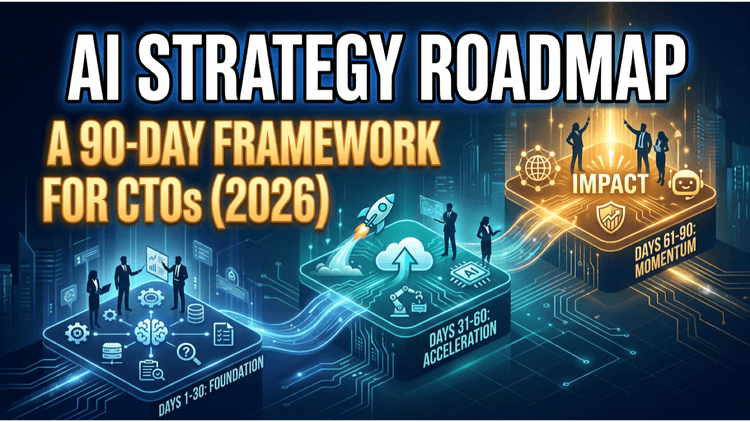
AI Strategy Roadmap: A 90-Day Framework for CTOs (2026)