
What Is Agentic AI and How Do You Integrate It Into Your Business?
You tell AI what to do. It does it.
That was the expectation for AI just a few years ago. You issued a command; it responded and stopped. You were in control of every step.
That's changed.
Now you give AI a goal. It decides for itself what needs to happen to reach that goal. It plans the steps, uses tools, evaluates results, and adjusts its path when needed. You define the starting point and the destination — AI figures out everything in between.
This is Agentic AI.
And it's fundamentally changing what artificial intelligence means for businesses.
The Difference Between Agentic AI and Ordinary AI
Let's make this concrete.
Ordinary AI: "Translate this customer email into English." → It translates. Done.
Agentic AI: "Analyze the incoming customer complaints, prioritize by urgency, draft responses for high-priority cases, log everything in the CRM, and notify the relevant team." → It completes all of these steps sequentially, without human intervention.
The difference isn't just technical. It's a difference in workforce design.
Ordinary AI is an assistant. Agentic AI behaves like an employee — but one that works 24/7, with a lower error margin and infinite scalability.
Why Does This Matter for Businesses Now?
As of 2026, half of all agentic AI projects are still stuck at the pilot stage. The reason isn't technical maturity, most companies simply don't know where to start.
But early adopters are experiencing real advantages:
Operational efficiency: Repetitive, multi-step processes get automated. Human teams can focus on strategic work.
Speed: A process that takes a person 3 hours can drop to 3 minutes with an agentic system.
Scalability: Business capacity grows without growing the team. The same system can serve 10 customers or 10,000.
Competitive edge: While competitors are still working manually, you're making faster decisions and taking faster action.
Which Business Processes Can Be Integrated?
Agentic AI operates across sectors and functions. The most common use cases:
Customer Communication
Classifying incoming requests, drafting responses, escalating urgent cases to the right team, sending follow-up reminders. Human involvement only at the approval stage.
Sales and CRM
Scoring leads, segmenting prospects, generating personalized outreach messages, automating pipeline updates.
Content and Marketing
Conducting market research, running competitor analysis, drafting content, preparing performance reports.
Finance and Operations
Processing invoices, detecting anomalies, auto-generating reports, managing approval workflows.
Software Development
Code reviews, generating test scenarios, analyzing bug reports, updating documentation.
Where to Start: 4 Steps
Agentic AI integration can feel like a massive transformation. But with the right approach, it starts with small steps.
Step 1: Choose the right process
Don't try to automate everything at once. Pick the most repetitive, most time-consuming, least creative process in your operation. Start there.
Step 2: Document the process
Write out exactly what the AI will automate, step by step. What inputs are needed? What decisions get made? What outputs are expected? Without this document, the system won't work.
Step 3: Run a pilot
Test at small scale. Review the system's decisions, catch errors, build trust. Don't move anything to production that hasn't passed a pilot.
Step 4: Scale
Once the pilot succeeds, expand to other processes. Each new integration builds on the last, and the system becomes smarter over time.
What to Watch Out For
Agentic AI is powerful, but not without risks.
Security and compliance: What data does the system access? What decisions can it make without human approval? These boundaries must be clearly defined.
Human oversight: "Fully autonomous" doesn't exist yet. Even the best systems require human supervision. Approval mechanisms for critical decisions are non-negotiable.
Technical infrastructure: Agentic systems must integrate with your existing software — APIs, data flows, security layers. Without these, the system floats in isolation.
Cultural readiness: Teams need to prepare for this shift. Replace "AI will take my job" fear with "AI is multiplying my capacity" understanding.
How Internative Manages This Transition
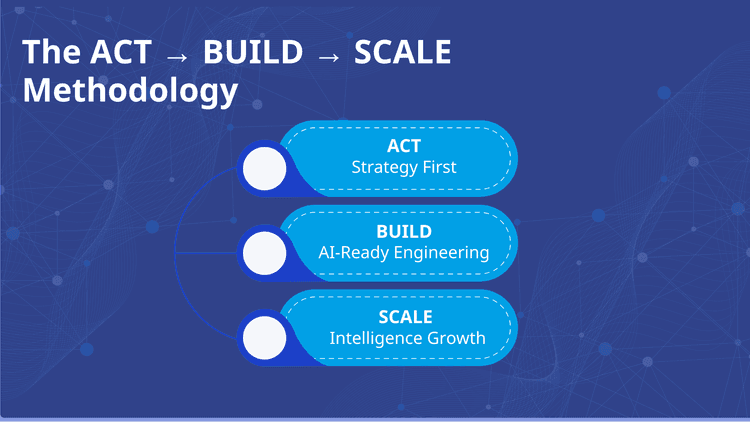
Our AI Studio service was designed exactly for this transformation.
We analyze our clients' business processes and identify where agentic AI can generate the most value. Then we design and deploy systems that produce measurable business outcomes, not just impressive demos.
We don't just set up the technology. We make it work.
If you're wondering which of your processes could be automated, reach out for a discovery session.
Let's Discover Agentic AI opportunities for your business → team@internative.net
Related services
Where this topic becomes an engagement.
Keep reading
More articles from Blog.