
From Writing Code to Writing Intent: How Software Development Has Changed
What did it mean to be a great software developer in 2010?
It meant knowing the right syntax. Memorizing frameworks. Spending hours debugging. Producing lines of code.
In 2026, the picture looks very different.
Today, the most valuable developer isn't the one who writes the most code. It's the one who can most clearly articulate what they want.
We call this intent-driven development. And it's not just a trend — it's a fundamental rewiring of how software gets built.
The Old World: The Reign of "How?"
Traditional software development revolved entirely around the question: "How do we build this?"
Want to add a feature? First, think through the architecture. Then design the data model. Then write the API endpoints. Then code the frontend. Then test. Then fix bugs.
Technical knowledge was required at every step. Business owners said what they wanted; developers figured out how to build it. Between them, there was always a translation problem.
That translation problem was the root cause of project delays, budget overruns, and the dreaded "this isn't what I expected" conversation.
The New World: The Rise of "What?"
Intent-driven development flips this equation.
The question now is: What outcome do you want?
"When users sign up, send an automated welcome email and a follow-up reminder three days later", that's an intent. Feed this to an AI system or a modern development environment, and it translates directly into working code.
"The sales team needs a weekly pipeline summary every Monday morning", that's an intent too. The system understands it, builds the data model, designs the interface, sets up the integration.
Code is still being written. Just not by humans, by human-directed systems.
Why Is This Happening Now?
Several forces matured at the same time.
LLMs entered production environments. Models like Claude, GPT, and Gemini aren't just generating text anymore, they're making architectural decisions, writing code, and catching bugs. And they're improving every month.
Development tools evolved. GitHub Copilot, Cursor, and Replit no longer do "autocomplete." They do "intent understanding." You write a comment; the system completes the function.
The economics shifted. Building a feature can now take 3 days instead of 3 weeks. That speed differential is fundamentally changing how companies think about software investment.
What Does This Mean for Developers?
This is the question we hear most often. The answer is simple but important:
Developers are becoming orchestrators.
The critical value now lies not in writing every line, but in defining what the system should do, reviewing outputs, directing architecture, and ensuring security and scalability.
Coding knowledge isn't becoming irrelevant but it's no longer sufficient on its own. Understanding systems, asking the right questions, and evaluating AI outputs are the new foundational skills.
What Does This Mean for Companies?
If your organization is still operating on a "hire developers, get them to write code" model, you're entering competitive disadvantage.
Companies adopting intent-driven development are experiencing:
Speed: Feature development cycles are dropping dramatically. If your competitor can iterate 3-4x faster than you, you're losing the product war.
Cost: Fewer human hours are needed to produce the same output, freeing resources for strategic priorities.
Quality: AI-assisted systems expand test coverage and catch errors that human eyes miss.
Flexibility: When the market shifts, adapting your product becomes easier. Static architectures are giving way to living systems.
How Internative Applies This Shift
We don't talk about this transformation theoretically. We live it in the field.
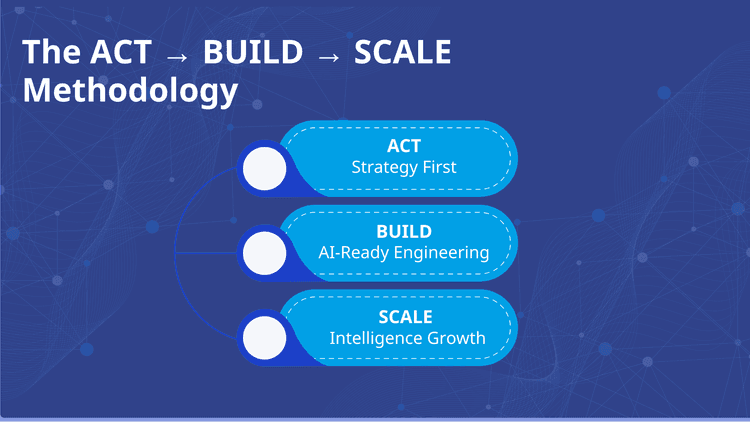
In our ACT → BUILD → SCALE methodology, the "BUILD" phase is now fully AI-assisted. We take our clients' business objectives, design the architecture to achieve them, and use AI tools strategically to multiply development speed by 3-4x.
Worktivity was built this way. From intent to product, and from product to market.
If you're ready to move your software development process into this new paradigm, let's talk.
Learn how to accelerate your software development with AI → team@internative.net
Related reading: custom software development — how to add AI to your existing software
Keep reading
More articles from Blog.