
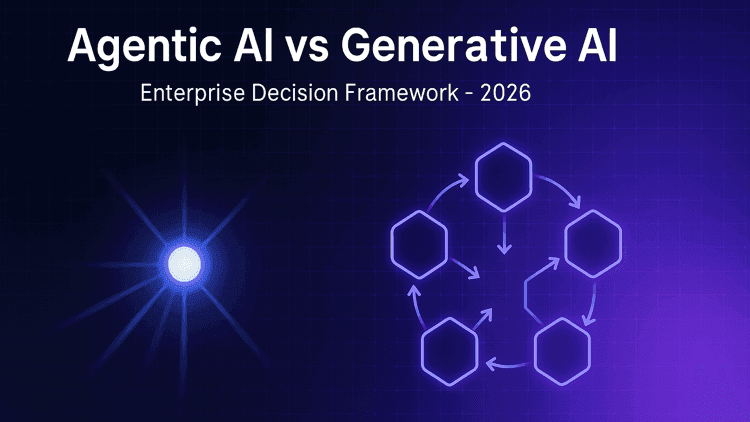
Agentic AI vs Generative AI: Enterprise Decision Framework (2026)
Generative AI writes the email. Agentic AI sends it, waits for a reply, negotiates a revised proposal with your calendar, and books the meeting. That sentence captures the whole difference, and also why enterprise teams keep confusing the two. This guide gives you a decision framework you can apply on Monday morning: where each approach fits in your stack, where they overlap, where mixing them is the right call, and where one of them is the wrong call dressed up in a hype cycle.
TL;DR — The one-minute answer
Generative AI produces content. You give it a prompt, it returns text, an image, audio, or code. Every call is stateless, bounded, and predictable in cost. Examples: ChatGPT writing a draft, Midjourney generating a product mockup, Copilot completing a function.
Agentic AI produces outcomes. You give it a goal, and it plans a sequence of steps, calls tools, observes the results, adjusts its plan, and repeats until the goal is met (or it gives up). Every run is stateful, unbounded, and variable in both cost and reliability. Examples: Cursor composer autonomously editing multiple files to fix a bug, an AI agent booking travel across three systems, a customer-support loop that opens a ticket, runs a diagnostic, applies a patch, and writes the resolution note.
Dimension · Generative AI · Agentic AI
Output — Generative AI: Content · Agentic AI: Outcome
Loop — Generative AI: Single-shot · Agentic AI: Multi-step, self-correcting
State — Generative AI: Stateless · Agentic AI: Stateful (memory, tools, scratchpad)
Cost profile — Generative AI: Predictable per call · Agentic AI: Variable, unbounded without guardrails
Best for — Generative AI: Drafting, summarising, classifying · Agentic AI: Executing workflows across systems
Failure mode — Generative AI: Wrong content · Agentic AI: Wrong action taken at scale
If you are still choosing between them, the answer is usually "you need both, in different places" — and the real question is where the boundary goes.
What generative AI actually is
Generative AI is the family of models trained on massive datasets that learn to produce new outputs conditioned on a prompt. The headline capability is generation from a natural-language instruction: write this, summarise that, translate here, extract the entities there. GPT-4, Claude, Gemini, Llama, Mistral, Gemma, and the image and audio equivalents (Flux, Midjourney, Stable Diffusion, ElevenLabs, etc.) are all generative AI.
A generative call is a function: input prompt → output content. State-of-the-art systems like GPT-4 Turbo, Claude Opus, and Gemini 2.5 are extraordinarily good at producing high-quality output, but the output is where it ends. The model does not know whether the email you just drafted was sent. It does not know whether the code it just wrote was committed. It does not have a memory of yesterday's interaction unless you explicitly stitch that in through retrieval augmentation.
This is not a limitation; it is a feature. A stateless, deterministic-in-spirit function call is easy to monitor, easy to cost, easy to cache, and easy to fail safely. If the output is wrong, you throw it away and try again. Nothing else moved.
What agentic AI actually is
Agentic AI is a workflow pattern built on top of generative AI. The underlying model is almost always a generative foundation model. What makes the system agentic is the loop.
A minimal agentic loop looks like:
- Observe — read current state (a ticket, a codebase, an inbox, a CRM record, sensor input).
- Think — the model reasons about the goal, the current state, and what tool to call next.
- Act — the model emits a structured tool call (search the database, run a test, send a message, write a file).
- Observe the effect — the result of the action becomes new state.
- Repeat — until the goal is met or a termination condition triggers.
Concrete agentic systems include Cursor Composer and Claude Code (multi-step coding agents), OpenAI's o1 reasoning chain paired with tools, LangGraph and AutoGen-style orchestrators, Anthropic's Claude with extended thinking and tool use, and emerging commercial platforms like Salesforce Agentforce, Microsoft Copilot Studio agents, and the enterprise agent products that Google, AWS, and Nvidia shipped through 2026.
The defining shift is from producing a single correct answer to driving a process to completion with many intermediate decisions. That is where the power comes from, and also where the risks come from.
Is ChatGPT generative AI or agentic AI?
ChatGPT is both, depending on which surface you mean.
The bare "chat with a model" experience is generative AI. You prompt, the model answers, done.
The same ChatGPT app with code interpreter, web browsing, file analysis, or custom GPTs with Actions is an agentic system built on a generative foundation. It observes the task, plans tool calls, runs them, observes results, and continues. Users don't see a sharp line — OpenAI and its competitors have been steadily merging the experiences — but under the hood it's the difference between a one-shot call and a multi-step loop.
The same is true for Claude with tool use, Gemini with the Code Assistant, or Copilot with Workspace. The model is generative; the product is agentic when it chains actions toward a goal.
What are the 4 types of AI? Where do these two fit?
The classic academic taxonomy of AI distinguishes four types based on capability level:
- Reactive machines — no memory, purely rules-based (classic chess engines).
- Limited memory — short-term state, most modern deep-learning systems.
- Theory of mind — hypothetical, models that understand others' mental states.
- Self-aware AI — hypothetical, models with subjective experience.
Neither generative nor agentic AI maps neatly to one of those four. Both sit squarely in "limited memory" on that scale. The generative-vs-agentic distinction is a deployment pattern, not a capability tier. You can wrap any sufficiently capable limited-memory model in either pattern.
That is why the useful framing for enterprise decisions is not "what type of AI is this" but "what pattern am I building with it".
The key differences — seven dimensions
1. Output shape
Generative AI returns content that a human or downstream system consumes. Agentic AI returns a completed outcome — the content is usually incidental.
2. Loop structure
Generative is single-shot. Agentic is a loop with observe-think-act-observe cycles that can run for seconds, minutes, or in extreme cases hours.
3. Statefulness
Generative calls are stateless by default; any memory you need is bolted on through retrieval augmentation or prompt stuffing. Agentic systems are stateful by design — scratchpads, memory stores, observation buffers, tool results. State management is the hard part of building one.
4. Cost predictability
A generative call has a bounded token count and a bounded cost. An agentic run can explode if the loop keeps trying. Real enterprise deployments discover this the hard way: an agent stuck in a retry loop burns tokens and money at industrial scale. Every agentic system needs explicit step budgets, cost guardrails, and fallback paths.
5. Failure mode
A wrong generative output is embarrassing. A wrong agentic action is operational. The agent sent an email, deleted a record, placed an order, ran a production migration. The failure radius is different, and so is the recovery plan.
6. Latency profile
Generative calls are single-digit seconds typically. Agentic runs are minutes. Product design must reflect this — you cannot put an agentic loop directly behind a "click and wait" button without rethinking the interaction pattern.
7. Monitoring surface
A generative call produces one observation: the output. An agentic run produces dozens to hundreds of intermediate observations, tool calls, reasoning traces, state transitions — all of which you need to log, replay, and audit when things go wrong.
What are examples of agentic AI? Where it actually lives
The best way to see the distinction is in real, shipping systems.
Software development. Cursor Composer, Claude Code, and GitHub Copilot Workspace operate as coding agents. You describe a feature or a bug, the agent reads your codebase, proposes a plan, edits multiple files, runs the tests, observes failures, revises. This is genuinely agentic — the output is a working pull request, not a text response.
Customer support. Tier-1 ticket triage agents read the ticket, search the knowledge base, query the customer record, check service status, decide whether to auto-resolve or escalate, post an update, close the ticket. Five to ten discrete steps per ticket.
Data operations. An agent fed a business question ("why did revenue drop in region X last quarter?") breaks it down into SQL queries, runs them, inspects the results, generates follow-up queries, assembles the analytical narrative. Data-team-in-a-box.
Sales and marketing workflows. Lead enrichment agents that scan a prospect's public footprint, cross-reference your CRM, rank the prospect, draft a personalised outreach sequence, and schedule it.
Finance operations. Expense reconciliation agents that match receipts to card transactions, flag anomalies, and request clarification.
Industrial IoT and physical operations. Agents that monitor equipment telemetry, recognise a degradation pattern, open a maintenance ticket, order parts, and schedule the technician.
What these have in common: they are workflows humans already perform repeatedly, the steps are well-defined enough to be tool calls, and the failure radius can be bounded (scoped credentials, dry-run modes, approval gates).
Enterprise decision framework
When a client asks our team whether to build something as a prompt, a retrieval-augmented generation (RAG) pipeline, or a full agentic system, the framework we use has five questions.
One: how many steps does the task take? One step, it's generative. Two or three fixed steps, it's probably a deterministic pipeline with a generative step in the middle. Variable, open-ended steps, it's agentic.
Two: does the order of steps depend on observations? If yes, you need the loop. If the order is fixed, you can use a deterministic workflow engine with LLM calls embedded — cheaper, more reliable, more auditable.
Three: what is the cost of a wrong action? If wrong content is the worst case, generative with human review is fine. If wrong action causes financial, operational, or reputational damage, every agentic action needs explicit approval gates or rollback paths.
Four: does the task have a natural stopping condition? Agentic loops need a termination signal. If the goal is fuzzy ("improve our marketing"), the agent will not know when to stop and will spiral. If the goal is concrete ("close ticket #12345"), you have a stopping condition.
Five: what's the latency budget? User-facing real-time means generative. Background, asynchronous, "I'll check back in an hour" means agentic is acceptable.
Most enterprise AI builds are not a single decision. A well-architected system has generative calls inside an agentic loop inside a deterministic workflow engine, each layer doing what it is best at. The AI integration consulting work we do with clients almost always starts by drawing this layered architecture before any model gets chosen.
Where they overlap — and where the hybrid lives
Generative and agentic are not competitors. Every modern agentic system is built on a generative foundation. Every modern generative product has nascent agentic features. The meaningful architectural choice is about where to put the generative components inside an agentic (or non-agentic) shell.
Three useful hybrid patterns:
Generative-in-deterministic-workflow. A fixed pipeline — fetch → classify → draft → human review → send — where the classification and draft steps are generative calls, everything else is deterministic code. Most "AI-powered" enterprise features today are this pattern, and that is a strength, not a weakness. It is cheaper, more observable, and easier to govern than an agentic loop.
Generative-in-tight-agentic-loop. A narrow agent with a small tool surface, a tight step budget, and aggressive termination conditions. Coding copilots, support triage agents, data analysis agents. The agent can reason and adapt, but within strict boundaries.
Generative-as-fallback-in-deterministic-pipeline. A deterministic rule engine handles 90% of cases; when it cannot decide, it hands off to a generative model for judgement and resumes the pipeline with the model's answer. Insurance claims triage, content moderation, fraud rules.
Avoid the opposite anti-pattern: the unconstrained agent with too many tools and no termination condition, marketed as "autonomous AI" and reliably failing in production by the third week.
Cost modelling — what changes when you add the loop
A generative call at 5,000 tokens prompt + 2,000 tokens output on a mid-tier model costs somewhere between one and three cents in 2026. You can model a month of traffic in a spreadsheet in five minutes.
An agentic run at the same mid-tier model averaging ten steps (which is a low estimate — production agents regularly hit twenty or thirty) and carrying its observation history forward runs 50,000 to 150,000 tokens per outcome. That is fifteen to fifty times the cost of a single generative call, with significant variance.
Three practical cost-control tactics that every production agentic system uses:
Step budget. Hard cap on the number of observe-think-act cycles per run. When the budget is hit, the agent must either return its best intermediate answer or escalate to a human.
Token budget. Parallel hard cap on tokens consumed. Needed because some agents trigger very long tool responses (a SQL query returning 100,000 rows, a codebase search returning thousands of files) and blow the budget inside a single step.
Model tiering. Route cheap decisions to a small model (Gemma 4 4B, Claude Haiku, GPT-4o-mini), reserve the expensive model for the final synthesis. A well-tiered agent runs 3-5× cheaper than one that defaults to the frontier model at every step.
Integration architecture — where each lives in your stack
In enterprise systems we build, the boundary usually looks like this:
- Workflow orchestration layer (Airflow, Temporal, LangGraph, custom) — deterministic, idempotent, auditable.
- Agentic layer (LangChain agents, Autogen, custom) — used only for steps with unknown ordering or observation-dependent branching.
- Generative call layer (direct LLM API calls) — the cheap, easy-to-reason-about primitive, called by both of the above.
- Retrieval layer (vector DB, document stores, knowledge graphs) — shared by both.
- Tool layer (internal APIs, external services) — exposed to the agentic layer through a tight, authenticated tool registry.
- Observability layer (LangSmith, Arize, Datadog, custom) — every step of every run is captured for replay and audit.
Without the observability layer, agentic systems in production are a liability. The cost of a ten-step agent failing invisibly is far larger than the cost of a generative call returning the wrong string.
Risks and limits
Generative AI risks you already know. Hallucinations, training-data bias, prompt injection on user-submitted input, copyright and trademark concerns in the output.
Agentic AI adds new risks.
Runaway cost. Covered above.
Unintended actions. An agent with write access to production systems will eventually take an action you did not intend. The mitigation is always the same: least-privilege tool access, dry-run modes, approval gates for high-stakes actions, comprehensive logging.
Compound error. Each step has a probability of error. Ten steps of 95% reliability is 60% end-to-end reliability. Production agentic systems need verification steps, retry logic, and human-in-the-loop checkpoints on any step whose failure is not recoverable.
Security surface. Every tool an agent can call is a potential exploit path if a prompt-injection attack succeeds against the agent. Tool allowlists, input sanitisation, and output validation are non-negotiable. Our security and compliance team treats agentic systems as a distinct threat model.
Auditability. Regulated industries need deterministic trails for decisions. Agentic systems generate trails, but "the model reasoned its way here" is not the same audit artefact as a deterministic rule. Choose the pattern with the auditability your regulator actually wants.
How this looks in practice at Internative
When a client engages us on an AI build, the first week is almost never about the model. It is about drawing the layered architecture above, deciding which steps are generative, which are agentic, and which are deterministic. In the last twelve months the split in our production deployments has been roughly:
- About half the AI features we ship are pure generative — classification, drafting, summarisation, translation. Cheap, predictable, high value.
- About a third are hybrid — generative-in-deterministic-pipeline with human review on the high-stakes path.
- The remainder are genuinely agentic, and those are the ones that take the most engineering work upstream in guardrails, observability, and cost controls.
That distribution matches what we see across the industry. Agentic is the category where hype runs ahead of successful production deployments, and where the difference between a good engineering team and a bad one shows up fastest. The payoff, when the architecture is right, is transformative — we have clients whose Tier-1 ticket volume has dropped 70% after agentic triage went live. The payoff, when the architecture is wrong, is a dashboard of "97 agent runs this week, 62 of them failed in ways nobody logged".
The agentic AI integration work we published earlier this year covers the integration patterns in more depth. This post is the decision framework that sits one level above it.
Getting started
Three concrete next steps if you are trying to pick a direction for your own team:
- Inventory the candidate tasks. List every workflow in your organisation where AI could help. For each, answer the five decision-framework questions.
- Start generative, escalate to agentic. Ship a generative version of the workflow first. When you have empirical data about where the model is wrong, where the human wastes time, and where the cost sits, you can make a defensible decision about whether to invest in the agentic loop.
- Invest in observability before agentic scale. You cannot run production agents without replay, audit, and step-level metrics. Build this once, reuse it across agents. Skipping this step is the single most common mistake we clean up when we come in after another team.
Our AI integration consulting practice helps enterprise teams make exactly these decisions and ship the resulting architecture — from initial workflow audit through production observability and cost controls. If you are debating generative vs agentic for a specific workflow and want a second opinion, start a conversation and we will put the framework above against your actual use case.
Related reading: AI integration services — how to add AI to your existing software
Related services
Where this topic becomes an engagement.
Keep reading
More articles from Blog.
Gemma 4 in Production: Cloud vs Self-Hosted vLLM Deployment Guide (2026)

The AI Wrapper Era Is Over: “AI-Powered” vs “AI-Labeled” Products Are Not the Same
AI and Web Development in 2026: The Trends Actually Reshaping How We Build
Building Intelligent Healthcare Systems: AI-Powered Patient Management in 2026