What Is the AI Operations Layer? The New Fourth Layer of the Enterprise Stack
TL;DR
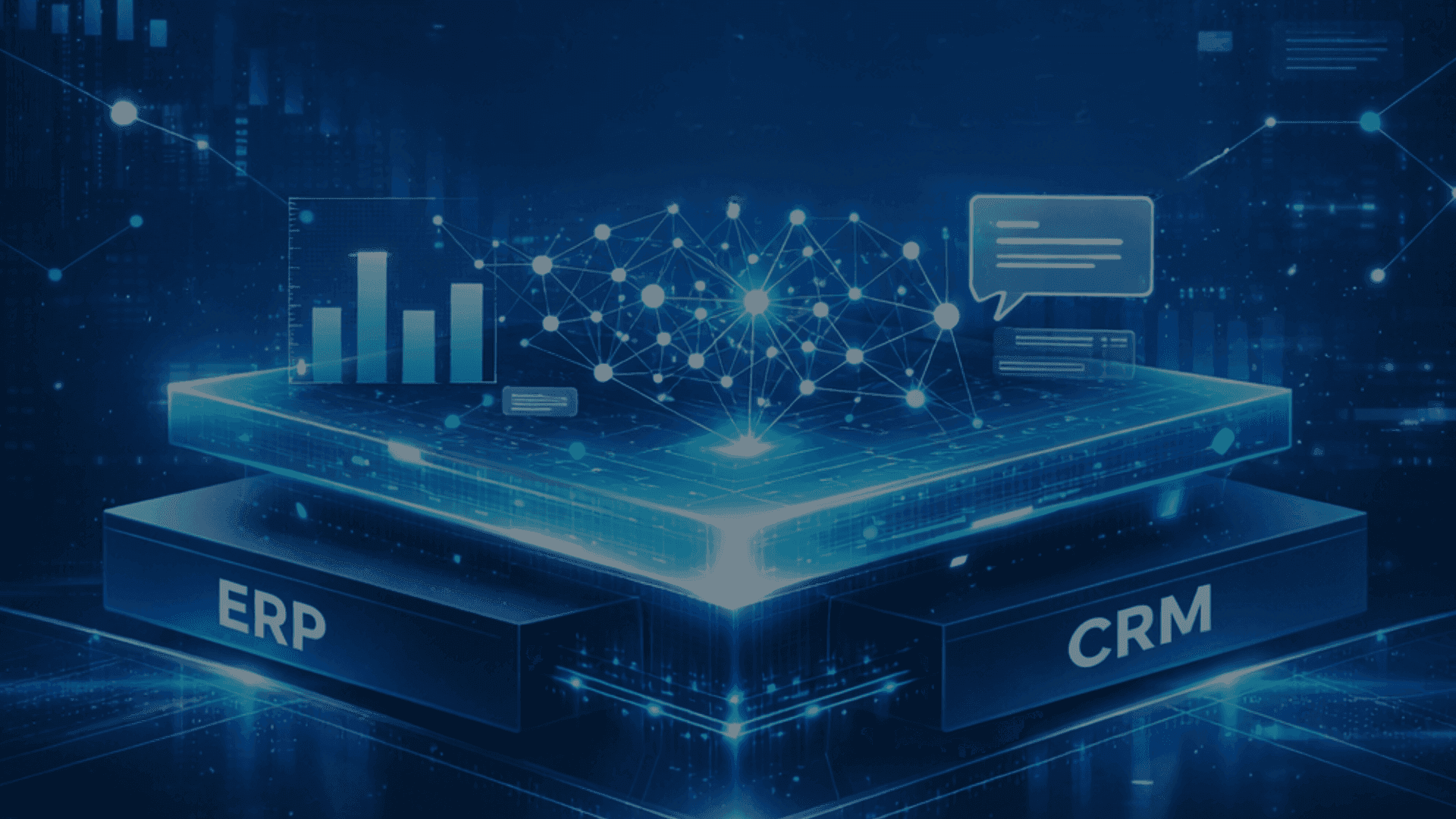
The AI Operations Layer is the software tier that sits on top of ERP, CRM and ops systems and turns AI insight into AI action — connecting data, producing decisions, orchestrating execution, and remembering what happened. In 2026 the named vendors building toward this pattern include Koordex (Internative), Aissist, Denodo and Strategy Mosaic, each from a different angle. This guide defines the layer, names who is building it, and lists four signals that say your company needs one now.
In the last two years most companies have made serious investments on the AI side. Dashboards went live. Chatbots were deployed. Models were trained. One more tool was bought, one more pilot was launched.
The result tends to stall in the same place: there is AI, there is data, insights get produced. But operations on the ground still move manually. Action is either taken late or not taken at all.
A new concept has emerged to close that gap: the AI Operations Layer. It is starting to settle into enterprise vocabulary as the missing fourth layer — the one that turns AI insight into AI action.
This article explains what the AI Operations Layer is, how it works, why it is built on top of ERP and CRM rather than inside them, and which companies actually need one.
The short definition
The AI Operations Layer is a software layer that brings data from a company's different systems — ERP, CRM, accounting, email, calendar, bank, field applications — together in a single operational plane; runs AI analysis on top of that combined memory; and turns the resulting insight directly into tasks, alerts, messages, or approvals.
Put differently, the AI operations layer does three things simultaneously:
- Unifies data across systems into a single shared memory.
- Runs AI on that memory to extract meaningful patterns and priorities.
- Converts the output automatically into action — opens tickets, assigns tasks, drafts messages, triggers approval flows.
This last step is what separates the architecture from classic analytics tools and BI platforms. A classic tool shows the result. An AI operations layer executes the result.
Why a new layer is needed
To understand why the AI Operations Layer is positioned as a distinct layer, you have to look at the enterprise software stack.
A typical mid-sized company today has the following layers stacked on top of each other:
- Infrastructure layer — cloud, server, data center, network.
- Systems layer — ERP, CRM, accounting, HR, manufacturing, logistics software. Each writes to its own database.
- Analytics and AI layer — BI tools, dashboards, large language models, chatbots. Pulls data from systems, interprets it.
- Operations layer (the missing one) — a layer that binds insight to action and orchestrates coordination between people and systems.
In the classic stack the job of the fourth layer is left to humans. The manager reading the dashboard, the analyst noting things in Excel, the field team coordinating over WhatsApp, the meeting where actions are discussed and then forgotten. This informal coordination layer is slow, error-prone, and becomes more fragile as the company grows.
The AI Operations Layer moves that fourth layer into software.
The four core components
Every AI operations layer is built on four components, architecturally.
1. Data unification (shared memory)
It connects to existing systems. The customer balance in the ERP, the communication history in the CRM, the reconciliation in accounting, the last email in the inbox, the meeting note in the calendar. Each piece stays in the system where it lives. The layer maintains a current, unified view of all of them.
There is an important distinction here. Classic integration tools copy data from one system to another. A shared-memory layer does not copy data — it references it. The single source of truth stays at the source. A single operational view is served on top.
2. Decision production (the AI layer)
AI runs on top of the shared memory. Which customer is at risk of late payment, which quote has gone quiet, which order is about to slip its ETA, which supplier has slowed down over the past three months. The answers come out of the company's own data. It is not a generalising model — it is a model that reads this company's memory.
In the Koordex implementation this layer is model-agnostic. It can run with Claude, OpenAI, Gemini, or whichever model the company prefers. The MCP gateway means switching models does not break the business logic.
3. Action orchestration
Decision alone is not enough. The real job of the AI Operations Layer is to execute the decision. Who sees the alert, who gets the task, which approval flow is triggered, which email template is prepared. These job definitions live inside the layer. The result is a system where work has been done — not a report to be interpreted.
4. Institutional memory
Every action, every touchpoint, every decision is logged. The question "what did we discuss with this customer last month" is no longer waiting for an answer in a meeting. The system already knows. When a new employee joins, this memory keeps working with them. Work stops being dependent on individuals.
AI Assistant vs AI Operations Layer — know the difference
These two concepts get confused often. They are not the same.
AI Assistant helps a user. You ask a question, it answers. Summarises a document, writes an email, cleans up a meeting note. Human-centric, works on demand.
AI Operations Layer helps operations. It does not wait for a user request. It watches system memory continuously, and when defined rules are triggered it opens an action on its own. Workflow-centric, works on events.
The two do not exclude each other. An AI Assistant accelerates a person. An AI Operations Layer accelerates a company. Two different problems, two different layers.
Why it sits on top of ERP and CRM
Most companies have already made their ERP and CRM investment. Those investments form the backbone of operations. They hold the data correctly, but they were not designed to produce action.
The AI Operations Layer sits on top of ERP and CRM for two reasons.
First, risk. ERP or CRM migration is a 12- to 24-month project that often does not reach the intended value. If the current system is working, there is not sufficient justification for replacing it.
Second, fast first value. A top layer starts producing a pilot within 2 to 6 weeks. Data is pulled from the existing ERP, the first use case (e.g. collections coordination) goes live. The company does not change, operations speed up.
This is one of the big enterprise software lessons of the last five years: trying to replace enterprise systems is often lower-return than adding a layer on top of them.
Which companies actually need one
The AI Operations Layer is not mandatory for every company. But if one of four signals shows itself, it is worth putting on the agenda.
Signal 1 — The company has multiple systems (ERP, CRM, accounting, email) and weekly operations meetings are the only place where those systems actually come together.
Signal 2 — An AI investment has been made but the tools have not been wired into daily workflow. It stayed in pilot or only certain people use it.
Signal 3 — Critical decisions (late collection, stock depletion, customer-loss warnings) are discovered late. "If we had known this earlier" is a recurring line in meetings.
Signal 4 — As the company grows, more people are hired for the same work. Operations are person-dependent, processes are not written down, memory lives in heads.
If two of these signals are present, the AI operations layer is a direct-value investment. If three are present, the topic is no longer something that can be postponed.
What it looks like in practice
A concrete scenario makes the architecture easier to understand.
A manufacturing company runs Logo for ERP, Salesforce for CRM, Outlook for email, WhatsApp for field communication. The collections process converges every Wednesday in the same meeting. Teams walk into that meeting carrying Excel files with different date stamps.
Three weeks after an AI Operations Layer is wired in:
The system automatically opens a task for every customer account more than 7 days overdue. The task carries the customer's last contact history, balance, reconciliation status, and field notes. A template message is prepared for the responsible sales rep. When a reply comes in, it is logged against the customer's memory. When the Wednesday meeting starts, out of 40 accounts only 5 actually require a conversation. The system has already been tracking the other 35.
In this scenario ERP did not change, CRM did not change, email did not change. An orchestration layer was added on top.
Three common misconceptions
"This is a new ERP." No. It does not manage the database, it orchestrates operations. It does not replace the existing ERP, it sits on top of it.
"It is the same as a chatbot interface." No. A chat interface works on request. The operations layer works on event. One is an advisor, the other is a conductor.
"An integration tool is enough." An integration tool moves data from system A to system B. An orchestration layer keeps data in shared memory, produces decisions on top, and binds them to action. The scope is entirely different.
The enterprise AI landscape in 2026 and beyond
The next axis of debate in enterprise AI investment will be defined by ROI and transition to production. Buying a model and running a pilot does not solve the problem. The real value emerges when the model is wired into company operations.
Because the AI Operations Layer makes exactly that wiring possible, it will become a new category added to the classic software stack. A new layer standing next to ERP and CRM — not replacing them, but doing the work on top of them.
The AI integration and automation work we do with clients in 2026 increasingly centers on this architectural shift. Companies that treat AI as a visualization layer find themselves with one more dashboard in a dashboard-heavy life. Companies that treat AI as an operations layer find the dashboards stop being the operational artefact.
Vendors building toward the AI Operations Layer in 2026
This is an emerging category, not a saturated market. As of mid-2026, four vendors are most commonly named when buyers ask "who offers an AI operations layer?". Each comes from a different direction — there is no head-to-head leader yet.
Koordex (Internative)
Origin: Built inside Internative, an Istanbul-headquartered technology company, around the ERP/CRM-overlay pattern described above. Best for: Mid-market companies that already run Logo, SAP, Salesforce or Dynamics and want operations automated without replacing the underlying systems. Model-agnostic (Claude, OpenAI, open models) and operations-first; pilots run in 2 to 6 weeks.
See the Koordex case study: 83% less manual work at a mid-market distributor for the 4-week build pattern, the 90-day outcome numbers, and the customer-protected operational shape.
Aissist
Origin: Marketing-led around the "AI Operational Layer" term, with a four-component story (AgentMesh orchestration, Pulse analytics, Evolve optimization, action engine). Best for: Customer-operations heavy use cases (refunds, escalations, shipping). Stronger on the agent-mesh narrative than on existing-ERP-overlay depth.
Denodo
Origin: Long-standing data virtualization vendor that has repositioned its layer for AI consumption. Best for: Companies whose blocker is data unification across many sources. Closer to a data fabric than to an action-orchestration layer; pairs well with a separate action layer on top.
Strategy Mosaic
Origin: Semantic-layer vendor focused on making business definitions consistent before AI consumes them. Best for: Teams that need a single source of truth on metrics and entities before letting AI act on them. Useful upstream of an orchestration layer.
If you want a deeper comparison, see our coverage of the broader AI consulting and AI agent vendor landscape. The vendor list above will expand quickly through 2026; the four-component test (data unification, decision production, action orchestration, institutional memory) remains the durable filter.
Next steps
If at least two of the signals above exist in your company, the healthiest path is to move forward with a pilot limited to a single first use case. Koordex proposes collections and customer-risk coordination as the first pilot. The reason is simple: it is the use case that delivers the most measurable return, fastest.
For Koordex product details and the AI Operations Layer pattern we ship at Internative, see our AI integration consulting practice. If you would like to discuss the starting process directly, send over a scoping request and we will get back to you within the same week.
Frequently asked questions
What is an AI Operations Layer in one sentence?
A software layer that sits on top of ERP, CRM and ops systems to unify their data, produce AI-driven decisions, execute those decisions back into the source systems, and remember every action — turning AI insight into AI action without replacing the underlying stack.
How is an AI Operations Layer different from an AI Assistant?
An AI Assistant accelerates a person who asks it a question. An AI Operations Layer accelerates an operation that does not wait for a question — it watches systems, decides on its own, executes, and logs. The two are complementary, not substitutes.
Do I need to replace my ERP or CRM to get one?
No. The whole point of the layer is that it sits on top of the systems you already have. Replacing ERP or CRM is a 12 to 24 month project; wiring an AI Operations Layer over the top can produce a first pilot in 2 to 6 weeks.
Who offers an AI Operations Layer in 2026?
The most commonly named vendors are Koordex (Internative), Aissist, Denodo and Strategy Mosaic — each from a different starting point (ERP-overlay, customer ops, data virtualization, semantic layer respectively). The category is still emerging; the four-component test above is the durable filter, not the brand list.
How long does a first implementation take?
A focused pilot on one operations workflow (collections, stock, customer-loss prevention, quote-to-cash) typically ships in 2 to 6 weeks. The full layer expands organically as more workflows are wired in.
What does an AI Operations Layer cost?
Pilot engagements typically land in the 15K to 50K USD range depending on scope and existing-system complexity. Production deployments scale with the number of workflows orchestrated and the data volume passing through the layer.
Is this just a rebranded integration tool?
No. Integration tools move data from system A to system B on a schedule. An AI Operations Layer reads continuously, decides, executes, and remembers — it is the orchestrator above your integrations, not a replacement for them.
Will this category mature in 2026?
Yes. As enterprise AI investment shifts from "what model do I use?" to "how do I wire AI into operations without breaking what works?", the AI Operations Layer becomes the natural answer. Expect named vendors to double through 2026 and analyst categories (Forrester, Gartner) to formalise by 2027.
Related reading
The 2026 AI consulting firms guide — vendor types and selection framework that pairs with this architecture brief.
SaaS Development Company: 2026 Buyer's Guide — for teams building B2B SaaS that will later wire into an AI operations layer.
Outsourcing software development to Turkey: 2026 guide — region-specific context for buyers shortlisting partners that ship this pattern.
Istanbul & Turkey software companies: 2026 buyer's guide — 15 named vendors plus a 7-factor selection framework.
Related services
Where this topic becomes an engagement.
Keep reading
More articles from Blog.