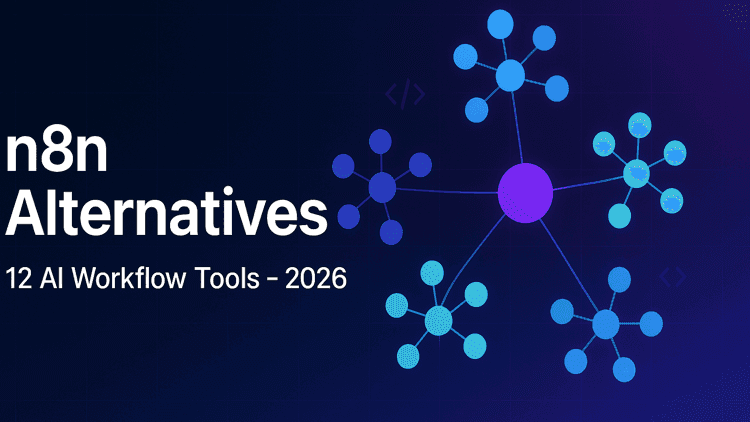
n8n Alternatives: 12 AI Workflow Tools Compared for 2026
n8n has had a remarkable year. The fair-code license change, the AI-agent nodes, the enterprise feature push, and the breakout growth in self-host deployments turned it into the default reference point for "developer-friendly workflow automation" in 2026. Which is also why "n8n alternative" is one of the hotter buyer queries right now — teams evaluating it want to know what else is in the landscape before they commit, and teams already on it are looking at options after hitting a ceiling they did not expect.
This guide maps twelve real alternatives with specific positioning. It is written for developers and technical product owners, not for procurement, so the questions are the ones engineers actually care about: self-host quality, code-first primitives, AI-agent maturity, pricing at real workloads, and migration complexity.
Why developers search for n8n alternatives in 2026
Three specific reasons keep coming up in the conversations we have with engineering teams.
Licensing nervousness. The 2024 fair-code license change caused real uncertainty. Most teams are fine with the terms, but "fine" is not the same as "comfortable over a 5-year horizon." Teams with strict open-source policies or competitive concerns with n8n's commercial offering look for a cleaner license.
Enterprise governance gap. n8n's enterprise tier improved rapidly through 2025-2026, but teams with strict audit, segregation-of-duties, or multi-tenant isolation requirements sometimes find it still lighter than Workato or Camunda.
AI-agent architecture ceiling. n8n's AI agent nodes are first-class but follow a specific pattern. Teams building agentic systems with heavy tool use, multi-agent coordination, or streaming sometimes hit architectural limits and look for Temporal, LangGraph, or custom orchestrators.
The right alternative depends on which of these three drove the search. A licensing-driven move needs a cleanly-licensed open source peer. A governance-driven move needs enterprise iPaaS. An architecture-driven move needs a different primitive.
Decision framework — which kind of alternative do you need?
Five questions sort the twelve candidates quickly.
1. Self-host priority — hard requirement or nice to have? Hard requirement narrows to Activepieces, Camunda, Temporal, Prefect, n8n self-host (obviously), and custom code-first builds. Nice-to-have opens the field to managed SaaS options.
2. Developer surface — visual, code, or both? Teams that want visual plus code-first escape hatches stay in the n8n-Activepieces-Tray lane. Teams that want pure code-first lean Temporal, Prefect, or Inngest. Teams that want pure visual fall back to Make or Power Automate.
3. AI-agent depth — table stakes or central? If agents are central (most 2026 builds are trending this way), Gumloop, Lindy, Vellum, and custom LangGraph builds are stronger. If agents are table stakes alongside classic workflows, n8n, Activepieces, and Workato are all fine.
4. Cost model sensitivity — per-run, per-user, or flat? Per-run scales with usage, punishes bursty workloads. Per-user scales with team size, punishes efficiency. Flat enterprise tier is simplest but expensive. Match the model to your actual usage shape.
5. Migration cost tolerance — how much effort to port existing workflows? Workflows in n8n typically do not migrate cleanly to any other platform; the format is specific. Plan for 30-70% of the original workflow development time as migration effort. Teams migrating serious workflow portfolios usually rebuild rather than migrate.
The 12 n8n alternatives — deep dive
Self-host, open-source, engineering-friendly
Activepieces (MIT license). The closest peer to n8n in positioning. Open-source core, commercial SaaS, strong self-host, fast-growing connector ecosystem. The UX is cleaner than n8n in places. AI-agent nodes arrived in Q3 2025 and continue evolving. If the motivation for leaving n8n is licensing or "second-opinion" architecture, Activepieces is the natural landing zone. Typical migration effort from n8n: moderate — the concepts map directly but the workflow format is different.
Camunda (Apache 2.0). Enterprise-grade BPMN workflow engine. Not a direct n8n replacement — Camunda is for classic business-process-with-human-tasks workloads rather than SaaS-integration-heavy automations. Teams come to Camunda when they realize n8n is the wrong primitive for regulated BPM work.
Temporal (MIT license). Not a workflow builder — a workflow-as-code orchestration engine. Workflows are written in code (Go, Java, TypeScript, Python, .NET, PHP). Exceptional for long-running, durable, complex orchestrations where the engineering investment is justified. Teams move from n8n to Temporal when agentic or complex orchestration patterns exceed what n8n's visual model expresses naturally.
Prefect (Apache 2.0). Data-orchestration-first workflow engine. Strong in ETL and data-pipeline use cases, weaker in SaaS-integration workflows. Teams use Prefect when the workloads are more "data engineering" than "business automation."
Apache Airflow (Apache 2.0). The established data-orchestration incumbent. Relevant if your workflow is data-processing-heavy. Not really an n8n peer — different problem shape.
Visual, managed, AI-native
Gumloop. AI-native from day one, not retrofitted. Clean visual builder specifically designed for agentic workflows. Good choice for teams whose dominant workload is AI orchestration (document processing, content generation, agent workflows) rather than SaaS-integration automation. Pricing is usage-based and predictable at moderate scale.
Lindy. AI-assistant-first workflow platform. Best positioned for customer-support and back-office automations where the dominant pattern is "an AI agent handling an end-to-end task." Good for teams building agentic features fast; less suited to traditional data-pipeline or integration workflows.
Make. Mid-market visual automation leader. Has AI nodes now but the AI-agent sophistication is below n8n or Gumloop. Teams move from n8n to Make when they want more polish, a bigger connector catalog, and a visual builder their non-technical colleagues can actually use.
Zapier. The breadth leader. AI features caught up in 2024-2026 with Zapier Agents and Copilot. Not a natural migration target from n8n for technical teams — most n8n users find Zapier's abstraction layer too thick. Right choice when integration breadth matters more than engineering control.
Enterprise iPaaS
Workato. Serious iPaaS + workflow with enterprise governance. Right destination when the motivation for leaving n8n is audit and compliance. Not cheap — enterprise entry point is north of $100K/year — but the governance story is comprehensive.
Tray.ai. Developer-friendly iPaaS, lighter governance than Workato but cleaner developer experience. Good middle ground for technical teams moving from n8n to an enterprise-tier platform without going all the way to Workato's cost profile.
Emerging and adjacent
Pipedream. Developer-first, code-heavy workflow platform. Good for teams that want event-triggered workflows defined in code (JavaScript or Python) without running their own infrastructure. Not a visual-builder competitor — a different developer surface.
Inngest. Event-driven, durable workflow engine with a code-first definition. Strong in event-sourcing and background job patterns. Teams migrate from n8n to Inngest when they need stronger durability guarantees and are comfortable trading the visual builder for code.
The twelve-way cheat sheet
Best fit by motivation:
- Licensing concerns (n8n fair-code) → Activepieces, Camunda, Temporal, Prefect
- Governance gap → Workato, Tray.ai, Camunda
- AI-agent architecture → Gumloop, Lindy, Temporal + LangGraph, custom
- Data-pipeline workloads → Prefect, Airflow, Temporal
- Long-running durable orchestrations → Temporal, Inngest
- Visual UX polish → Make, Activepieces, Gumloop
- Integration breadth → Zapier, Make, Tray.ai
- Pure code-first primitives → Temporal, Prefect, Inngest, Pipedream
Open-source deep dive
The open-source corner of the landscape has consolidated meaningfully in 2026. Four serious options:
Activepieces (MIT) — the closest drop-in spiritual n8n alternative. Cleanest license. Growing ecosystem. Enterprise features still maturing but shipping fast.
n8n self-host (fair-code) — still the dominant choice for self-hosted workflow automation despite the license concerns. Ecosystem is mature. Enterprise features shipped in late 2024 and continue evolving.
Camunda (Apache 2.0) — when the workflow is a business process with human tasks, approvals, and BPMN semantics. Not for SaaS-integration automations.
Temporal (MIT) — when the workflow is long-running, durable, and complex. Workflow-as-code. Best-in-class durability story.
The choice among these four depends on workload shape, not on which has the most GitHub stars.
AI-agent alternatives
For teams whose primary motivation is stronger AI-agent orchestration, five options are serious:
Gumloop — visual, agent-native, fast iteration. Good for rapid exploration of agent workflows.
Lindy — agent-first, focused on customer-facing workflows (support, email, back-office).
LangGraph (framework) — code-first agent orchestration. Maximum control, requires engineering investment. Often combined with Temporal or another durability layer.
Vellum — AI workflow builder focused on prompt engineering and evaluation. Narrower scope than n8n but deeper in the model-interaction layer.
Custom LangGraph + Temporal — the "roll your own" pattern for teams with engineering maturity who want complete control over the agent architecture.
n8n's agent nodes cover a specific, opinionated design. Teams that need to go beyond that opinion usually do not want another opinionated tool — they want a composable primitive.
Self-hosted vs managed SaaS decision matrix
For each of the twelve alternatives, the self-host-vs-managed decision:
- Activepieces — both, self-host is production-ready.
- n8n — both, self-host is production-ready.
- Temporal — both, self-host is excellent (Temporal Cloud for managed).
- Prefect — both (Prefect Cloud for managed).
- Camunda — both (Camunda Platform 8 SaaS for managed).
- Make, Zapier, Workato, Tray.ai, Gumloop, Lindy, Pipedream — managed only.
- Airflow — both, but most enterprise users choose Astronomer, MWAA (AWS), or Cloud Composer (GCP) for managed.
Self-host is almost always more cost-effective above a certain workload threshold (roughly 1M+ operations per month), but the operational burden is real.
Integration ecosystem comparison
n8n's integration count (500+) is impressive but not unique. Here is how the twelve alternatives compare:
- Zapier: 6,000+ integrations (category leader)
- Make: 1,400+
- Workato: 1,000+
- Tray.ai: 750+
- Activepieces: 450+ (fast-growing)
- n8n: 500+ (for reference)
- Power Automate: hundreds, concentrated in Microsoft ecosystem
- Pipedream: 2,000+ components
- Others (Temporal, Prefect, Camunda, Gumloop, Lindy, Inngest): fewer native connectors — integration comes through SDKs, HTTP, or custom code
Integration count matters less than integration depth. A 6,000-connector platform that exposes a shallow "common verbs only" surface for each tool is less useful for complex workflows than a 500-connector platform that exposes the full API surface of each integration.
Build-your-own when none fit
Some teams correctly conclude that no off-the-shelf alternative fits their specific needs. Building your own workflow engine is reasonable when:
- The workflow is genuinely part of the product (user-facing, differentiated)
- The integration layer is non-standard (legacy systems, proprietary protocols, internal platforms without REST APIs)
- The scale justifies the engineering investment (typically millions of operations per month)
- The team has the engineering maturity to operate a distributed system
The build path almost always starts with Temporal, Inngest, or a similar durable-execution primitive plus custom UI. The combined pattern is "Temporal for execution, custom React UI for workflow definition, internal integration library for connectors."
Our AI integration consulting practice has built this pattern for clients where the economics of an off-the-shelf workflow platform at expected scale would exceed the engineering cost of a purpose-built solution.
PAA — the questions developers ask
Is there anything like n8n for free?
Activepieces is the closest peer with a cleaner license (MIT). n8n self-host is also free if the license terms work for you. Camunda Community Edition and Temporal are fully free open-source, but they solve different problems — Camunda for BPMN business processes, Temporal for code-first durable orchestration.
Does Microsoft have something similar to n8n?
Microsoft Power Automate is the closest equivalent in the Microsoft ecosystem. It is deeply integrated with Microsoft 365 and Azure. Often bundled into E3/E5 licenses, which makes the economics very different from n8n. The developer experience is heavier than n8n — Power Automate is designed for business users first.
What is Google's alternative to n8n?
Google Cloud Workflows is a closer primitive than a direct alternative — it is YAML-defined, server-side workflow orchestration, lower-level than n8n. For visual workflow automation, Google's answer in 2026 is Vertex AI Agent Engine for agentic workflows and Application Integration for iPaaS-style integration. Neither is a direct n8n equivalent.
Migration effort estimates
Moving from n8n to each alternative, rough engineering cost for a 30-workflow portfolio of moderate complexity:
- n8n → Activepieces: 2-4 weeks. Closest format match.
- n8n → Make: 3-6 weeks. Visual concepts transfer; specific connector behavior differs.
- n8n → Zapier: 3-6 weeks. Simpler workflows migrate well; complex multi-branch logic requires refactoring.
- n8n → Workato or Tray.ai: 4-8 weeks. Enterprise features add complexity; governance design is the hardest part.
- n8n → Temporal or similar code-first: 6-12+ weeks. Total rewrite as code.
- n8n → Gumloop or Lindy: 2-4 weeks per workflow if the workflow is agent-shaped; most workflows will need redesign rather than migration.
Migration costs for serious workflow portfolios are usually a significant line item. Budget accordingly.
Internative's n8n alternative recommendations
When clients engaged on workflow automation programs come to us with "we want to move off n8n" or "we are evaluating n8n vs X," the recommendation pattern is consistent:
If the motivation is licensing nervousness: move to Activepieces. Cleanest license, closest feature match, shortest migration path.
If the motivation is enterprise governance: move to Workato (expensive, comprehensive) or invest engineering effort in hardening n8n self-host (cheaper, more work).
If the motivation is AI-agent architecture: usually not a platform move — build agent workflows on Temporal + LangGraph for durability + flexibility, keep operational workflows on the existing platform.
If the motivation is cost at scale: self-host n8n longer, or evaluate whether the workload shape justifies moving to Temporal or Prefect (cheaper at scale but higher engineering load).
If the motivation is simply "we are not happy": dig deeper before migrating. Most "n8n is not working for us" problems are workflow design problems, not platform problems. A week of architectural review usually clarifies whether the platform needs to change.
Next steps
If you are evaluating n8n alternatives, three concrete steps:
- Name the specific motivation. License, governance, AI-agent, cost, or unhappiness with design patterns. The right alternative depends on the answer.
- Prototype on the top candidate, not on paper. A two-week production prototype against a real workflow tells you more than any vendor demo.
- Estimate migration cost honestly. Most n8n portfolios take longer to migrate than teams expect. Plan the full cost, not the optimistic cost.
Our AI integration and automation practice runs exactly this evaluation with clients moving between workflow platforms. If you are in the middle of a workflow tool decision and want a second opinion, start a conversation and we will send a structured review within forty-eight hours.
Related reading: AI integration services — how to add AI to your existing software
Related services
Where this topic becomes an engagement.
Keep reading
More articles from Blog.