Klarna's AI Reversal: A Postmortem in Three Lessons
In February 2024, Klarna told the world it had replaced 700 customer service jobs with an AI assistant. The number circulated fast. Investor decks referenced it. Tech press treated it as a milestone for AI in the workplace. The narrative was clean: AI works at scale, savings are real, the future is here.
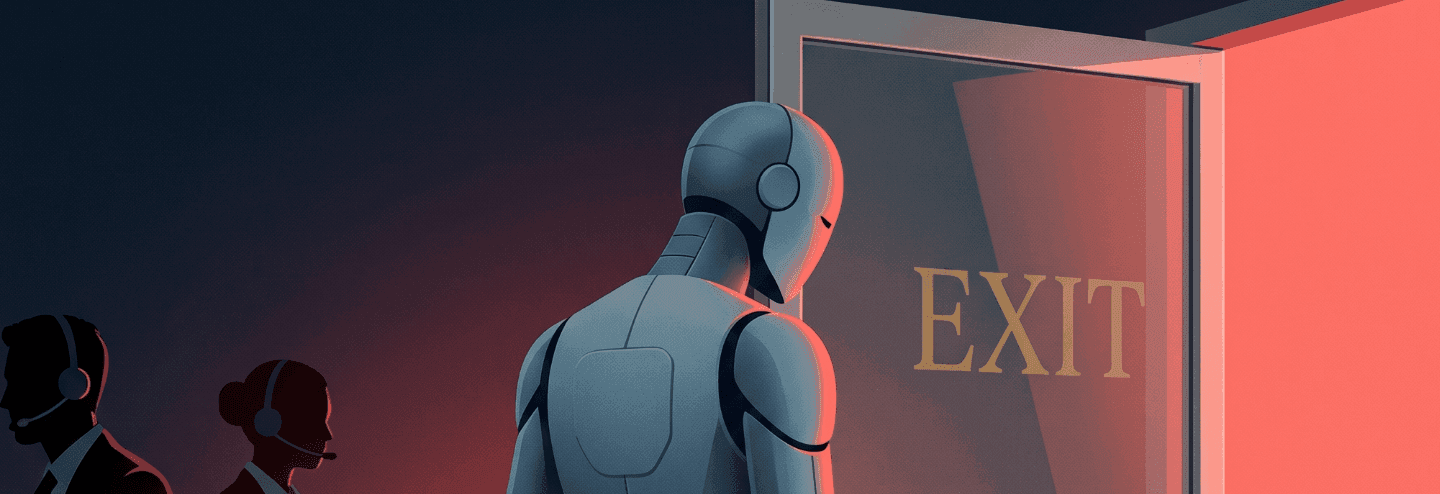
In May 2025, Klarna walked it back.
Founder and CEO Sebastian Siemiatkowski told Bloomberg the company was hiring humans again. His exact words: "Cost, unfortunately, seems to have been a too predominant evaluation factor when organising this. What you end up having is lower quality."
The company is now piloting an "Uber-style" hiring model with remote agents from rural Sweden, students, and dedicated Klarna users. The savings narrative is gone. The replacement narrative is gone. What remains is one of the most public AI rollout reversals to date, and a lot of quiet relearning at companies that were following Klarna's playbook.
This piece is a postmortem in three structural lessons. Not a hot take. Not an "AI was always going to fail" argument. AI did not fail Klarna. The way Klarna measured AI did.
Lesson 1: Cost-first AI rollouts have a hidden quality lag
Here is the timeline that matters.
In Q1 2024, Klarna's AI assistant, built in partnership with OpenAI, began handling what the company described as the equivalent work of 700 full-time customer service agents. By mid-2024, Klarna was claiming the AI managed two-thirds to three-quarters of all customer interactions. The savings story showed up immediately in operating expenses. Press coverage was generous. The number "700 jobs" became its own marketing asset.
What did not show up immediately was customer satisfaction data. That always takes longer.
Customer satisfaction is what economists call a lagging indicator. It moves slowly, and the signals it produces in week one of an AI rollout look almost identical to the signals it produced in the last quarter under human staff. By the time satisfaction scores meaningfully decline, six to twelve months have already passed. By the time those declines correlate with churn, retention impact, and brand metrics, you are eighteen months out.
Klarna's reversal happened roughly fourteen months after the original AI announcement. That timing is not a coincidence. It is exactly the lag window where customer behavior catches up to operational changes.
For any team running an AI rollout, the structural takeaway is uncomfortable: the savings story you can tell next quarter and the quality story you will be forced to tell next year are two different stories. They get evaluated at different speeds, and they almost never agree.
The teams that get this right do something simple. They tie any reported AI savings to a 12-month customer satisfaction floor. If satisfaction drops below the floor in that window, the savings number stops being celebrated and starts being reviewed. Klarna did not publicly tie one to the other, and by the time the reckoning came, the savings narrative had already shipped to investors and IPO planning.
Lesson 2: "AI handles X% of queries" is a routing metric, not a quality metric
The most repeated number in Klarna's AI story was that the assistant managed two-thirds to three-quarters of customer interactions. Read that sentence again carefully.
It does not say "resolved." It does not say "satisfied the customer." It does not say "did not need human escalation." It says "handled."
In customer service operations, "handled" is a routing metric. It tells you which channel or system the query touched first. It does not tell you whether the query was answered well, whether the customer came back with the same issue, whether the interaction ended in escalation, or whether the customer simply gave up and stopped engaging.
Customers told Klarna which one was happening. As reported by FinTech Weekly and Vice, Klarna saw increased customer complaints, lower satisfaction ratings, and persistent frustration with what users described as generic, repetitive replies that failed to handle nuanced issues.
Two metrics were being conflated:
- Deflection rate: the percentage of incoming queries that the AI agent took on as the first responder
- Resolution rate: the percentage of those queries that ended with a satisfied customer and no follow-up needed
Deflection looks great with AI. Resolution often does not. The gap between the two is where customer relationships erode quietly, and it is where most cost-justified AI rollouts have their blind spot.
The tactical fix is not exotic. Instrument resolution rate from week one. Track it weekly. Compare it to the human baseline before the AI was introduced. If resolution drops while deflection rises, you are not saving money. You are deferring a cost to a later quarter where it will show up as churn, refund volume, or social media noise.
Klarna's CEO eventually said the quiet part out loud in his Bloomberg interview: cost evaluation dominated the rollout, and quality dropped as a result. This is the same conclusion the company would have reached if they had been measuring resolution rate from the start.
Lesson 3: Customer satisfaction is a 6-to-12-month lagging indicator
The third structural lesson is the one that surprises operations teams the most. Most companies treat customer satisfaction as a current-period metric. They look at it the same way they look at conversion rate or NPS. Movement in a quarter feels meaningful. Stability feels reassuring.
That mental model is wrong for AI rollouts.
When a company replaces a human-driven service layer with an AI-driven one, the change in customer experience is not felt immediately. Customers adapt. They try the new system, get a generic answer, give up on getting a real resolution, and lower their expectations. They do not always complain. They just stop expecting good service. The drop in satisfaction shows up in survey data only after the customer has had multiple bad interactions and decided that the bad interaction is the new normal.
By that point, retention has already been hit. Churn cohorts that look fine in a current-quarter dashboard reveal themselves as compromised four to six quarters later. Net revenue retention numbers that informed IPO valuations get recalculated against the customer base that actually stayed, not the one that signed up.
Klarna's IPO narrative through 2024 leaned heavily on operational efficiency, including AI-driven savings. By the time the May 2025 reversal happened, the narrative had to be rebuilt. The company was no longer telling a story about replacing humans. It was telling a story about hybrid customer experience and pilot hiring models. That is a different valuation story.
For any team in an AI rollout, the structural takeaway is to build a "satisfaction floor" gate before publicly attributing savings to AI. Do not write the press release in month two. Do not put the savings number in the next earnings deck. Wait for the lag window to close. If satisfaction holds, then attribute. If it drops, the savings were borrowed from future revenue, and you need to know that before the market does.
The bigger pattern
AI rollouts that optimize for cost without instrumenting for quality measurement create the same structural blind spot as the outsourcing waves of the 2000s and the offshoring waves of the 2010s. The tool changes. The blind spot does not.
In all three cases, the savings show up in the next quarter. The quality cost shows up two years later. The companies that get burned are the ones who treat the savings as the headline, lock it into investor expectations, and then have to publicly walk it back when behavioral data catches up.
The companies that do not get burned do something boring. They instrument quality at the same time as cost. They publish both metrics internally. They treat savings as provisional until the lag window closes. They do not ship a customer-facing AI rollout to investors before they ship it to customers.
In our own partner conversations at Internative, we are seeing a similar pattern emerge across mid-market companies that aggressively cut customer-facing roles in 2024 and 2025. Many are now quietly rebuilding the human layer. The hardest part is rarely the technical rebuild. The hardest part is admitting that the original measurement model was wrong, not just the rollout itself.
The Klarna reversal is going to be a case study in business schools and AI governance frameworks for the next decade. The lessons are not about whether AI works. AI works. They are about whether the way we measure AI rollouts is honest with the customers we are using AI on.
What to do if you are mid-rollout
If you are in the middle of an AI customer service rollout right now, three concrete actions:
- Audit your metrics. Write down every metric you are using to evaluate the rollout. Categorize each one as "operational" (cost, deflection, throughput) or "quality" (resolution, satisfaction, retention). If you have more operational metrics than quality metrics, you are in the same blind spot Klarna was in.
- Instrument resolution rate this week. Not next quarter. This week. Compare it to your pre-AI baseline. If you do not have a pre-AI baseline, document this as a measurement gap and stop attributing AI savings until you do.
- Build a satisfaction floor gate. Decide before the rollout reports savings what level of satisfaction drop would trigger a review. Write it down. Tie the savings narrative to it. If the floor breaks, the savings stop being a press release.
If you want a second pair of eyes on your AI rollout measurement model, get in touch at team@internative.net. We have been having this exact conversation with mid-market clients for the last six months, and the pattern repeats more often than we would like.
Sources
- Klarna Turns From AI to Real Person Customer Service (Bloomberg, May 8, 2025)
- Klarna plans to hire humans again (Fortune, May 9, 2025)
- Klarna CEO says company will use humans to offer VIP customer service (TechCrunch, June 4, 2025)
- Klarna Is Hiring Customer Service Agents After AI Couldn't Cut It (Entrepreneur, May 2025)
- Klarna Reverses Course on AI Customer Support, Resumes Human Hiring (FinTech Weekly)
- Klarna CEO admits aggressive AI job cuts went too far (mlq.ai)
Related services
Where this topic becomes an engagement.
Keep reading
More articles from Blog.