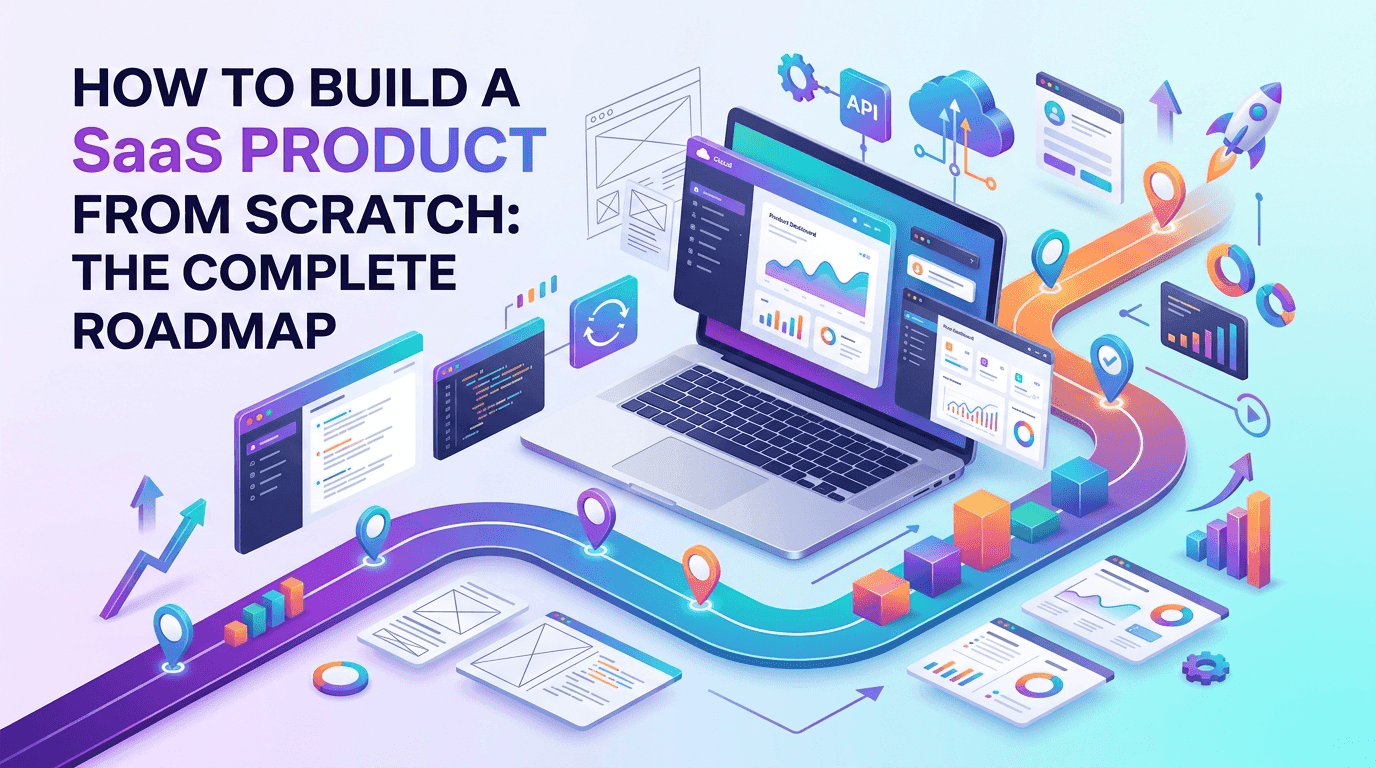
How to Build a SaaS Product from Scratch: The Complete Roadmap 2026
The SaaS market will reach $908 billion by 2030. Behind that number is a harder truth: 92% of SaaS startups fail within the first three years. The difference between the 8% that survive and the rest isn't a better idea — it's better execution of the fundamentals.
Building a SaaS product from scratch feels overwhelming because most guides either oversimplify the process into "find a problem, write code, launch" or bury you in technical jargon. The reality sits in between: building a successful SaaS product is a structured process with clear phases, predictable challenges, and proven solutions.
This guide walks you through every phase — from validating your idea to scaling your product — with practical frameworks, realistic timelines, and the hard-earned lessons that separate successful SaaS products from expensive experiments.
Phase 1: Validation — Before You Write a Single Line of Code
Problem Validation
Every successful SaaS product starts with a problem worth solving. Not every problem qualifies. The problem you solve needs three characteristics to support a SaaS business: it recurs frequently enough to justify ongoing subscription costs, it affects enough people or businesses to create a viable market, and people or businesses are already spending money or significant time trying to solve it.
Validate your problem through direct conversations with potential customers — not surveys, not assumptions. Talk to at least 30 potential users. Ask about their current solutions, what frustrates them, and what they've tried. If you can't find 30 people who care about this problem, that's valuable information.
Market Validation
A real problem doesn't automatically mean a viable SaaS market. Evaluate the competitive landscape, willingness to pay, and market size. Look for markets with existing solutions that have clear weaknesses — this signals demand but leaves room for a better product. Completely empty markets often indicate the problem isn't painful enough to pay for.
Solution Validation
Before building anything, validate your proposed solution. Create a detailed mockup or clickable prototype and test it with your target users. Can they understand what the product does in under 30 seconds? Does the workflow match how they actually work? Would they switch from their current solution? The answers shape everything that follows.
Phase 2: Planning — Architecture, Stack, and Scope
Defining Your MVP Scope
The most common SaaS mistake is building too much before launching. Your MVP (Minimum Viable Product) should solve the core problem and nothing else. List every feature you've imagined. Now cut 70% of them. The features that remain should directly address the primary pain point you validated.
A good MVP scope typically includes core functionality that solves the main problem, user authentication and basic account management, a simple billing integration, essential analytics or reporting, and basic admin capabilities.
Choosing Your Technology Stack
Your technology stack should be boring — proven, well-supported, and suited to your team's expertise. In 2026, the most reliable SaaS stacks include:
• Frontend: React, Next.js, or Vue.js — all have massive ecosystems and hiring pools
• Backend: Node.js, Python (Django/FastAPI), or Go — choose based on team expertise
• Database: PostgreSQL remains the default for most SaaS. Add Redis for caching
• Infrastructure: AWS, Google Cloud, or Azure. For simpler products, Vercel or Railway reduces DevOps overhead
Avoid the temptation to use cutting-edge technology. Your competitive advantage should come from your product, not your stack.
Multi-Tenancy Architecture
SaaS products serve multiple customers from a single codebase. Your multi-tenancy approach is one of the earliest and most consequential architectural decisions. Shared database with tenant isolation (most common for early-stage SaaS) offers the simplest management and lowest cost. Separate databases per tenant provides stronger isolation but increases operational complexity. Hybrid approaches work well as you scale — start shared, migrate high-value tenants to dedicated resources.
Security Architecture
Security isn't a feature you add later — it's a foundation you build from the start. At minimum, your SaaS needs encrypted data at rest and in transit, role-based access control, secure authentication (OAuth 2.0, MFA), regular automated security scanning, audit logging for sensitive operations, and a clear data retention and deletion policy.
Phase 3: Development — Building the Product
Sprint Structure for SaaS Development
Two-week sprints work well for most SaaS development. Each sprint should deliver a usable increment — not just code, but something a real user could test. Structure your sprints around user stories, not technical tasks. "As a user, I can invite team members" is better than "build invitation API endpoint."
Core SaaS Components to Build
• Authentication & user management: Registration, login, password recovery, SSO integration, role management
• Billing & subscription: Stripe or Paddle integration, plan management, usage tracking, invoice generation
• Tenant management & feature flags: Plan-based feature access, usage limits, upgrade prompts
• Analytics & reporting: Usage metrics, business dashboards, exportable reports
• API layer: REST or GraphQL endpoints, webhooks, authentication tokens
The 80/20 Rule of SaaS Features
In most successful SaaS products, 20% of features drive 80% of user value. Identify those features early and make them exceptional. The remaining features should work reliably but don't need to be best-in-class. This focus prevents the feature bloat that kills development velocity and user experience.
Phase 4: Launch Strategy
Beta Program
Launch a private beta with 20-50 users before going public. These early users are your most valuable asset: they'll find bugs, request features, and — if they love the product — become your first advocates. Offer meaningful incentives for beta participation: lifetime discounts, influence on the roadmap, or early access to new features.
Pricing Strategy
SaaS pricing is both science and psychology. Core principles that consistently work: offer 3 tiers (starter, professional, enterprise) to provide anchoring and choice, price based on value delivered not cost incurred, include a free trial (14 days is the sweet spot for most B2B SaaS), and make the upgrade path obvious and friction-free.
Don't underprice to gain traction. Cheap pricing attracts price-sensitive customers who churn faster and demand more support. Price for the customers you want, not the customers you're afraid to lose.
Go-to-Market Essentials
• Landing page: Clear value proposition, demo or video walkthrough, social proof (beta testimonials), and frictionless signup
• Onboarding: Onboarding email sequence, in-app tutorials, knowledge base with common workflows
• Initial traction: Content marketing (blog, guides), targeted outreach, community building, and strategic partnerships
Phase 5: Growth and Scaling
Metrics That Matter
• MRR/ARR: Monthly and Annual Recurring Revenue — your north star financial metric
• Churn rate: The percentage of customers who cancel — aim for under 5% monthly for B2B
• CAC: The cost to acquire one customer — should be recoverable within 12 months
• LTV: Total revenue from a customer over their lifetime — should be at least 3x CAC
• Activation rate: The percentage of trial users who become paying customers
Scaling Challenges
The challenges at 100 users are different from 1,000, which are different from 10,000. Anticipate technical scaling (database optimization, caching, CDN, load balancing), support scaling (self-service resources, AI-assisted support, tiered support), organizational scaling (hiring, processes, documentation), and financial scaling (managing cash flow as revenue grows but costs front-load).
Key Takeaways
First, validate ruthlessly before building. The most expensive mistake in SaaS is building a product nobody wants. Invest weeks in validation to save months in wasted development.
Second, scope your MVP mercilessly. Launch with the minimum feature set that solves the core problem. You can always add features — you can't recover lost months and budget.
Third, architecture decisions compound. Multi-tenancy, security, and data architecture choices made in month one affect every month that follows. Get expert input on these decisions even if you build everything else yourself.
Fourth, pricing is strategy, not math. How you price signals who your product is for, positions you in the market, and determines your growth dynamics. Don't default to copying competitors.
Fifth, plan for the stage after launch. Most SaaS founders focus obsessively on launch and underinvest in what comes after — retention, support, iteration, and growth. The real work starts at launch, not before.
Need a Technical Partner for Your SaaS Vision?
Building a SaaS product from scratch requires two things that are hard to find together: deep technical expertise and a genuine understanding of product strategy. Getting the architecture wrong in month one creates technical debt that compounds for years. Choosing the wrong stack limits your scaling options. Missing security fundamentals puts your customers at risk.
At Internative, we partner with founders and businesses to build SaaS products that are architected for scale from day one. We bring experience across the full SaaS stack — from multi-tenant architecture and billing integration to AI-powered features and enterprise security.
Book a free SaaS consultation at https://internative.net/get-quote
Frequently Asked Questions
How long does it take to build a SaaS product from scratch?
A focused MVP takes 3-5 months. A full-featured V1 takes 6-12 months. Timeline depends on complexity, team size, and scope discipline. The biggest timeline risk is scope creep — adding features before validating the core product.
Can I build a SaaS product without technical co-founder?
Yes, but you need a reliable technical partner. Non-technical founders succeed when they focus on product vision, customer development, and go-to-market — and partner with experienced developers for the build. The key is finding a partner who understands SaaS architecture, not just coding.
What's the minimum budget to build a SaaS product?
A basic MVP can be built for as low as $15,000-30,000 with a focused scope and experienced team. A more comprehensive V1 typically ranges from $50,000-150,000. The biggest cost factor is complexity — a simple workflow tool costs far less than a data-heavy analytics platform.
Should I use no-code tools to build my SaaS?
No-code tools like Bubble or Retool can work for validating an idea or building internal tools. For a commercial SaaS product you plan to scale, custom development is almost always the better choice. No-code platforms introduce performance limitations, vendor dependency, and customization constraints that become painful at scale.
How do I protect my SaaS idea?
Ideas aren't protectable — execution is. NDAs with development partners are standard practice, but your real protection is speed of execution, customer relationships, and continuous iteration. By the time a competitor copies your V1, you should be on V3.
What's the most common reason SaaS products fail?
Building something nobody wants to pay for. The second most common reason is running out of money before finding product-market fit. Both are preventable with rigorous validation before building and disciplined MVP scoping that gets you to market faster.
Keep reading
More articles from Blog.