
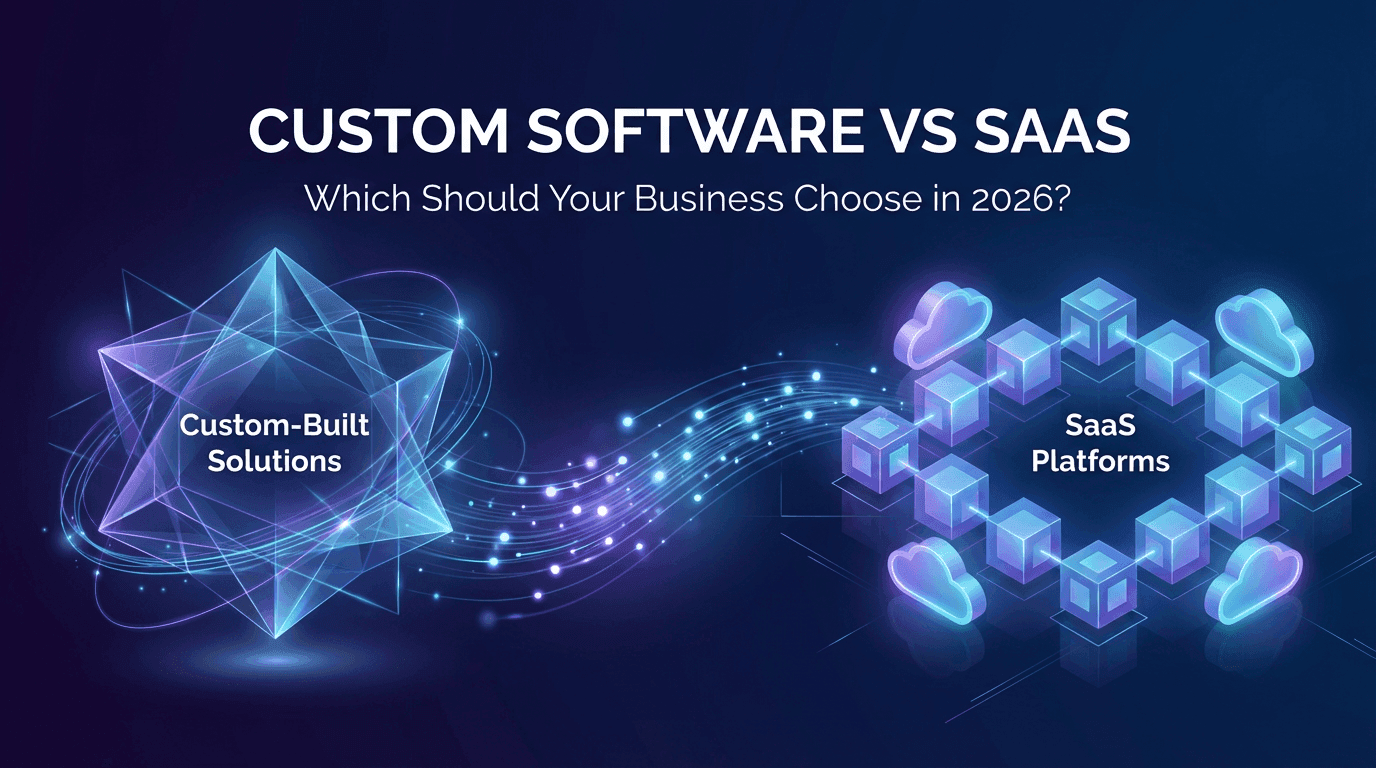
Custom Software vs SaaS: 2026 9-Question Decision Framework
Every mid-market and enterprise tech org runs into this decision every 2 to 3 years:
Renew the existing SaaS licenses, or build a single custom platform that consolidates them?
Run a 36-month TCO model and the totals often come out similar. But which one is the right decision is not always obvious.
The answer does not live in the cost comparison.
The real question is:
“What do you want to own in 5 years? A vendor-dependent operation, or a modular system under your control?”
The decision depends on 9 factors. We have worked through this question with enterprise and scale-up clients across the UK, US, EU and Türkiye since 2017. These are the factors that matter, plus the four scenarios where each option is the clear right call.
Why this decision got harder in 2026
In the 2010s, the answer was simple:
Off-the-shelf SaaS was fast, cheap and agile. Custom software was slow, expensive and heavy.
For 90% of small-to-mid-market businesses, SaaS was the right call.
In 2026, that equation shifted because:
SaaS pricing is escalating 25-35% annually in enterprise contracts. A 3-year lock-in compounds the total cost.
GDPR, SOC 2, CCPA and sector regulations increasingly require data residency control. Global SaaS hosted in US-East or EU-West servers no longer satisfies many enterprise procurement teams.
AI execution layers require native integration with your existing operational stack. Most off-the-shelf SaaS APIs are not deep enough.
Automatable work has grown from 20% to 60-70% of operational hours. This is easy to model in custom code, but hard inside the constraints of a SaaS workflow engine.
So in 2026, the decision is strategic, not just mathematical.
The 9 factors below are your map.
9 Decision Factors
1. How Unique Are Your Business Processes?
If 80% or more of your operational processes are sector-standard, such as generic CRM, invoicing or inventory, SaaS fits.
If 30% or more of your processes are genuinely your own way of doing things, adapting to SaaS means forcing your business to match someone else’s product.
Quick test:
“How many processes do I describe by starting with ‘we do this our own way because...’?”
Three or more means custom software belongs on the table.
2. Integration Depth
Off-the-shelf SaaS typically ships with a list of ready integrations, such as Salesforce, HubSpot, Shopify, Slack and similar tools.
If that list covers your stack, SaaS works.
But if your integration map includes the following, the decision changes:
- Legacy ERP systems such as SAP ECC, Oracle EBS, Microsoft Dynamics on-prem or regional systems like Logo, Netsis and Mikro
- A homegrown legacy system you have outgrown
- Custom APIs or internal services
-Niche vertical tools, such as veterinary PMS, maritime logistics or healthcare PMS
If those define your integration map, SaaS gives you half a solution. Custom gives you the full picture.
3. Data Residency and Compliance
This factor has become a hard gate, not a preference.
GDPR’s Article 49 international data transfer rules, CCPA’s data minimization requirements and sector regulations, such as HIPAA in healthcare, FedRAMP for US government and BSA banking requirements, increasingly require granular control over where data lives and how it moves.
SaaS:
Most global SaaS products store data in US-East or EU-West. Adapting compliance to your sector’s specifics is often blocked by the vendor.
Custom:
You choose AWS regions such as Frankfurt, London or Bahrain, on-premise deployment or hybrid architecture. Compliance is configurable, not constrained.
If you process sensitive customer data, such as B2C, healthcare, finance, education or government data, custom is the stronger direction.
4. 3-Year Total Cost of Ownership
The SaaS pricing trap is simple:
Monthly per-user fees look low.
The real TCO math is different.
SaaS TCO includes:
Monthly per-user fee × user count × 36 months
Integration projects
Custom feature requests, often rejected or expensive
Data migration, if required
Annual price escalation, typically 25-35%
Custom software TCO includes:
Initial build investment
Annual maintenance, typically 15-20% of the build cost
Incremental cost for new modules
General rule:
Custom TCO typically beats SaaS TCO when user count exceeds 50 and the time horizon is 3+ years, especially under per-seat SaaS pricing models.
Detailed ROI and payback calculations are available in our Custom Software ROI Framework blog.
5. Time-to-Value
SaaS is fast.
You can have a working system in 2 weeks to 2 months.
Custom is slower.
A typical enterprise build runs 6 to 12 months.
If you need a working solution right now and cannot wait 6 months, SaaS is the tactical right answer.
Custom can follow later.
Hybrid approach:
Start with SaaS, build custom in parallel, then migrate at month 12 to 18.
Many growing companies follow this exact path naturally.
6. Team Capacity
Owning custom software means owning an operational asset.
Annual maintenance, monitoring, security updates and feature pipeline management are all required.
SaaS:
The vendor owns it. You use it. Around 0.5 FTE from your IT team is usually enough.
Custom:
You own it. 1 to 3 FTE of in-house or outsourced maintenance is required.
A 5 to 10 person lean startup with limited technical capacity can usually sustain SaaS more easily.
A 50+ person mid-market business with engineering capacity can manage custom software.
7. Customization Scope
SaaS customization is typically cosmetic.
You can change the logo, adjust colors or add a custom field.
Core business logic stays fixed.
Custom software can change anything:
Workflow logic
Business rules
Data model
User experience
Integration structure
Quick test:
“Are there 5+ specific things I want this system to do differently from the SaaS default?”
If yes, SaaS will likely frustrate you.
Custom is the stronger answer.
8. IP Ownership and Vendor Independence
SaaS means renting.
Custom means owning.
Do not let the metaphor become abstract. Its strategic consequences are concrete.
SaaS:
If the vendor goes under, raises prices 5 times or kills a feature you depend on, your options are limited. In most cases, your escape path is a 6+ month migration project.
Custom:
The code is yours. You can switch vendors, extend the product or productize it as a B2B SaaS.
This is exactly how Worktivity, our own 10K+ user B2B productivity SaaS, came out of an internal custom build.
If you are considering selling, scaling or entering new markets in the next 5 years, IP ownership alone often justifies the custom investment.
9. Sector Fit and Compliance
In some sectors, “SaaS” is a non-starter in RFP evaluation.
For example:
Banking:
US OCC, EU PSD2 and UK PRA rules often require on-premise or private cloud deployment.
Healthcare:
HIPAA and sector-specific rules require patient data localization.
Defense and government:
Vendor-approved and government-certified solutions are often mandatory.
Public sector:
FedRAMP, ISO 27001 and regional sovereignty certifications may be required.
If you operate in one of these sectors, the question is not really open.
Custom is the stronger direction.
4 Scenarios: When to Pick Which
Scenario 1: Small business, lean operations, speed-to-launch
Best fit: SaaS
A 10-person startup, low user count, standard processes and a need to ship fast.
Salesforce, HubSpot and QuickBooks can get you running in weeks.
In 3 to 5 years, when scale shifts, revisit the decision.
Custom now is premature optimization.
Scenario 2: Mid-market, distinctive processes, sensitive data
Best fit: Custom
A 100 to 500 person mid-market business with its own way of doing things, processing customer or regulated data, and already running 50+ SaaS seats at $200K+ annually.
Custom platform ROI typically pays back in 12 to 18 months.
Do not delay.
Scenario 3: Enterprise, legacy stack, adding AI or agentic layers
Best fit: Custom + AI execution layer
Organizations with SAP, Oracle, Dynamics or legacy ERP stacks that want to add agentic AI on top need deeper integration than most SaaS products can provide.
Off-the-shelf SaaS will not integrate at this depth.
Vendors may claim, “we have an API,” but it often falls apart in production.
Custom build plus an AI execution layer, such as Koordex, our AI execution platform, is the only realistic path.
This is the fastest-winning category in 2026.
Scenario 4: Hybrid “build and buy”
Best fit: Hybrid
Some processes should stay on SaaS.
For example:
Email marketing
Payment infrastructure
Other standardized operational tools
Other processes should be custom.
For example:
Core business logic
Customer management
Sector-specific workflows
Modern correct answer is usually this hybrid structure.
Keep SaaS for plumbing. Build custom for business differentiation.
This keeps the cost optimized and preserves agility.
Decision Matrix
Under 10 people, lean startup
SaaS: Right answer
Custom: Poor fit, usually premature
Hybrid: Could work in some cases
50+ SaaS seats, prices escalating 25-35% per year
SaaS: Could work short term
Custom: Right answer
Hybrid: Right answer
Processing sensitive data, such as B2C, healthcare or finance
SaaS: Poor fit
Custom: Right answer
Hybrid: Right answer
Critical integrations with legacy ERP, such as SAP, Oracle or Dynamics
SaaS: Poor fit
Custom: Right answer
Hybrid: Right answer
30% or more of processes are uniquely yours
SaaS: Could work, but with limits
Custom: Right answer
Hybrid: Right answer
Need a working system in under 6 months
SaaS: Right answer
Custom: Poor fit
Hybrid: Right answer if you start with SaaS
Planning to sell, scale or expand the product in 5 years
SaaS: Poor fit
Custom: Right answer
Hybrid: Could work in some cases
Operating in banking, healthcare, defense or government
SaaS: Poor fit
Custom: Right answer
Hybrid: Could work in some cases
Have an in-house engineering team with 3+ developers
SaaS: Could work
Custom: Right answer
Hybrid: Right answer
Want to add AI or agentic layers on existing ERP
SaaS: Poor fit
Custom: Right answer
Hybrid: Right answer
3 Final Questions Before Deciding
1. Three years from now, which mistake would I regret more?
“We should not have built custom.”
Or:
“We should not have locked into SaaS.”
If the answer is the second one, lean custom.
2. If I treat this investment as expense instead of capital, what am I losing?
IP, flexibility, market entry speed and vendor independence do not show on the balance sheet immediately.
But they show up as painful costs in 3 to 5 years.
3. Do my CTO, CFO and COO all give the same answer?
If they do not, the decision is not mature yet.
One more 90-minute discovery session is needed.
Conclusion
Custom software vs off-the-shelf SaaS does not have a universal answer.
But with the 9 factors above, it should become clear which one fits your specific situation.
Two wrong answers we see frequently:
“Always SaaS” because it is “modern” and “fast”
Modern depends on context.
Fast works against you when vendor lock-in compounds.
“Always custom” because “we want control”
Early-stage custom investment requires operational capacity that most lean teams do not have.
The right answer is usually:
Hybrid with intentional pivots.
Start with SaaS for plumbing. Build custom as your competitive moat.
If you want to apply the decision matrix to your specific situation, email support@internative.net with a short description of your scope.
In a 60-minute session, we walk through the 9 factors with your scenario and produce a clear decision table.
No vendor pitch. Just the framework, calibrated to you.
Related Reading
The ROI of Custom Software: A 2026 Calculation Framework
Custom Software Development: The Complete Guide for Businesses (2026)
Enterprise Software Vendor Selection: 2026 CTO Checklist (38 Questions)